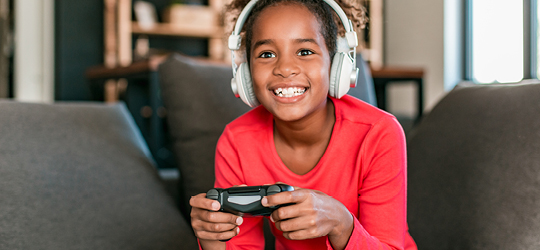
Video games have been a topic of debate for many years, with some people considering them a waste of time and others recognizing their potential as educational tools. Recent research has shown that playing video games can help children develop academic and social-emotional skills. In this blog post, we will explore the benefits of using video games to teach kids academic and social-emotional skills, citing peer-reviewed texts.
Academic skills
One of the most significant benefits of using video games to teach kids academic skills is that they make learning fun. When children are having fun, they are more likely to engage with the material and retain what they learn. A study published in the Journal of Educational Psychology found that children who played an educational game improved their reading and math skills more than children who were taught the same material in a traditional classroom setting (Gee, 2003).
Video games can also be used to teach problem-solving skills. In a study published in the Journal of Educational Psychology, researchers found that playing video games that require problem-solving skills can help children develop better problem-solving skills in real-life situations (Greenfield, 2014).
Social-emotional skills
Video games can also help children develop social-emotional skills. According to a study published in the Journal of Adolescent Research, playing video games with others can help children develop social skills such as cooperation, communication, and empathy (Wright, 2011).
Video games can also be used to teach children emotional regulation skills. In a study published in the Journal of Youth and Adolescence, researchers found that playing a video game that teaches emotional regulation skills can lead to improved emotional regulation in children (Frosch, 2017).
Conclusion
Video games have the potential to be powerful educational tools for children. They can be used to teach academic skills like reading, math, and problem-solving, as well as social-emotional skills like cooperation, communication, empathy, and emotional regulation. While video games should not be used as a substitute for traditional classroom learning, they can be a fun and effective way to supplement and enhance learning.
To learn more, visit treffertcenter.com.
References
Gee, J. P. (2003). What video games have to teach us about learning and literacy. New York, NY: Palgrave Macmillan.
Greenfield, P. M. (2014). Mind and media: The effects of television, video games, and computers. Cambridge, MA: Harvard University Press.
Wright, M. F. (2011). Cooperative and competitive play in multiplayer video games. Journal of Adolescent Research, 26(3), 319–343.
Frosch, C. A. (2017). Playing to regulate: A randomized controlled trial of a video game to improve emotion regulation in children. Journal of Youth and Adolescence, 46(10), 2071–2085.