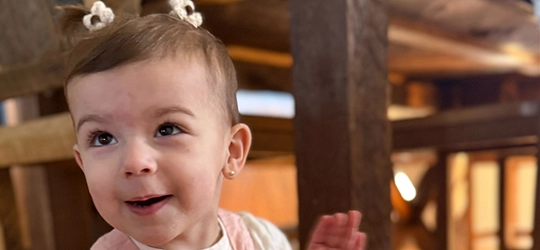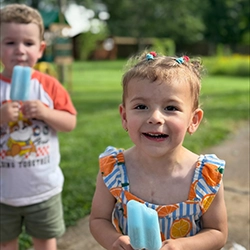
Mid-morning on July 31, Margarita Aguirre and Bobby Peters got a call from SSM Health Cardinal Glennon Children’s Hospital that could change the life of their 2-year-old daughter, Luciana.
Three days later, Luciana became the hospital’s first recipient of a domino partial heart transplant — a leading-edge procedure available at only one other hospital in the Midwest, and fewer than a dozen across the country. On Aug. 12, in the healing garden at Cardinal Glennon Children’s Hospital in St. Louis, her parents and surgeon joyfully shared the news with the media.
“We are incredibly proud of this achievement. A partial living heart transplant offers children with complex congenital heart disease in the St. Louis area access to innovative heart care — that might otherwise require them to travel far from home, or they simply wouldn’t have access to,” said Dr. Peter Pastuszko, Division Director of Cardiothoracic Surgery and lead surgeon in the procedure.
He was joined in the press conference by Dr. Vernat Exil, Division Director for Cardiology, and Dr. Andrew White, Chairman of Pediatrics at Saint Louis University and the hospital’s Chief Medical Officer.
“This takes an entire team — surgeons, cardiologists, transplant specialists, nurses, and many others — working together for one goal: helping children thrive,” Dr. Pastuszko said.
Luciana was born with a rare heart valve defect, truncus arteriosus, and had undergone standard valve repair surgeries that failed. Until this groundbreaking procedure emerged, there had been no ideal valve replacement options for children: Mechanical valves come in fixed sizes, require taking lifelong blood thinners, and are not available in sizes small enough for some infants and young children. Cryopreserved donor valves, and valves made from cow or pig tissue, are also limited because they can wear out quickly in young children.
None of those options can grow with the child — requiring multiple open-heart surgeries throughout childhood and adolescence. But this new procedure, which provided a living heart valve that will grow along with Luciana, could break that cycle.
The domino effect
Unlike a typical organ transplant, the “domino” heart transplant performed by Dr. Pastuszko and his team involved not two individuals, but three. One deceased donor heart made it possible to help two other children.
First, Patient A received a full heart transplant in a hospital in another state. Although Patient A’s heart muscle was failing, the aortic and pulmonary valves remained healthy. After Patient A's heart was removed, those valves were donated and transported to Cardinal Glennon Children's Hospital for Luciana.
By making use of healthy valves that might otherwise be discarded, partial heart transplantation can expand the supply of donor valves rather than compete with the supply of donor hearts.
“This procedure reminds us of the power of generosity. It would not have been possible without a heart donor, and we should remember and honor that child’s family,” said Dr. White. “Their sacrifice is a beautiful example of how compassion can change lives – in this case, not just for one transplant recipient, but for two, in ways we once thought impossible.”
Because the first partial heart transplant was performed just four years ago, researchers are still learning about its long-term outcomes. Early experience has been encouraging, but it will take time to understand how well these living valves perform over 10, 15, or 20 years and how consistently they grow with children as intended.
While the outcome is not assured, this procedure brings hope for a brighter future to families like Luciana’s. Her mom, Margarita Aguirre, was excited at the opportunity to share their story, and to spread news of this new opportunity for similar children to access groundbreaking care in their community.
“It’s an honor to participate in any way,” she said. “We are so proud to be a Glennon family.”