Sometimes life offers us gentle reminders. Other times, it delivers wake‑up calls that shake us to our core.
This is one of those stories.
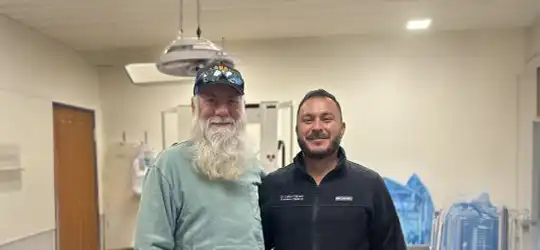
Last December, Patrick Koch of Shawnee, Oklahoma, spent the day doing what brought him joy—playing Santa Claus at various community activities and spreading cheer. He felt fine, just another day of smiles and laughter. But the following day was different. Something felt off. Koch was unusually tired. He was sweating. And there was a burning sensation in his chest that he couldn’t explain.
It would have been easy to brush it off. To chalk it up to exhaustion. To wait and see if it passed.
But Koch didn’t.
A retired Marine Corps gunnery sergeant and former police officer, Koch had taken first responder courses years earlier. He knew the signs. More importantly, he trusted his instincts. That inner voice telling him something wasn’t right was louder than any excuses he could have made.
“I told my wife, I’m pretty sure there’s something serious going on,” Koch recalled. “Not sure what it is, but I think I need to go to the emergency room.”
They called 9-1-1 and Koch was taken by ambulance to the SSM Health St. Anthony Hospital-Shawnee emergency department.
That decision—made in a moment of uncertainty—saved his life.
At the SSM Health St. Anthony Hospital–Shawnee Emergency Room, Dr. Carlos Cabrera quickly discovered the cause: a “widowmaker” blockage. The term alone is chilling. A widowmaker heart attack occurs when the heart’s largest artery, the left anterior descending artery, is blocked—cutting off blood flow to about half of the heart muscle. Without immediate treatment, survival is far from guaranteed.But Koch got help in time…before the widowmaker turned into an actual heart attack.
Dr. Cabrera acted quickly. Koch’s arteries were cleared, and he soon began follow‑up care with cardiologists. Thanks to that swift intervention, Koch now looks forward to many more years—not just of good health, but of dressing up as Santa Claus and bringing joy to others.
“Everything just lined up perfectly for him to have the great outcome he did,” Dr. Cabrera said. “If he ignored his symptoms and the heart attack would have happened at home or in the middle of the night, he might not be here today.”
Koch reflects on that day often, especially one memory that stayed with him from his first responder training. An instructor once shared how he saved his own life by recognizing the signs of a heart attack and waiting for help to arrive.
“That really stuck in my mind that day,” Koch said.
Now, Koch hopes his story can do the same for others.
In particular, he wants fellow veterans to listen—to their bodies, to their instincts, and to the people who care about them. “Veterans are hard-headed when it comes to health issues,” he admitted. “So, I’m hoping my story might help another veteran recognize symptoms and take action.”
Heart attack symptoms don’t always look the way we expect. They aren’t always dramatic or sudden. Sometimes, they whisper—through fatigue, discomfort, or a vague sense that something just isn’t right.
Koch listened.
And because he did, his story continues. Currently under a cardiologist’s care, Koch proudly announced his heart has gone from 25% -- meaning the heart pumps only a quarter of the blood it should with each beat -- to 55% -- considered at the lower end of the normal range, but indicating a generally healthy heart function.
Listen to your heart—it just might save your life. ❤️
Talk to your doctor about your heart disease risk and ways to improve your heart health.