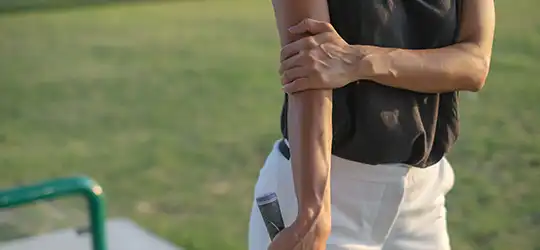
Golf is considered a leisure sport, which explains why it is so popular with children and adults. Golf is a fun, low-impact, outdoor activity that most everyone can do, and it engages family and friends with all levels of play. However, as with any sport, injuries can happen. Golfers are especially prone to injury because of the repetitive motions needed in each swing.
According to an article published in the British Journal of Sports Medicine, 60 percent of amateur golfers are injured at least once. Occasionally acute, traumatic injuries occur on the course, but nearly half of injuries (44 percent) are caused by repetitive movements and overuse.
Common injuries
Here are some common golf injuries for each region of the body, with tips to prevent or treat injuries safely.
Back pain
Back pain is the most common complaint among golfers. The mechanics that go into a golf swing affect the lower back for amateur and professional players. Aches in the back muscles usually start during or just after the activity, and are related to tension, overuse, or injury of specific muscles. Muscle aches and pains are common and can involve more than one muscle and other soft tissues such as ligaments, tendons, and fascia. However, low back pain also can be attributed to arthritis, spinal disc issues, and spinal stress fractures, if it persists long-term.
Low back pain among golfers typically can be resolved with rest, physical therapy, or other orthopedic treatment.
Elbow injuries
Golfers are more likely to injure the tissues on the inside of the elbow. This is called golfer’s elbow, or medial epicondylitis. Golfer’s elbow usually happens by striking the ground with the club during your swing.
Aside from pain, people who suffer from medial epicondylitis also may feel stiffness in their elbow or weakness in their hands or wrists. The nerves that run through this part of the elbow can be damaged, which causes numbness, tingling, or a pins-and-needles sensation (called paresthesia) in the hands or fingers. Lateral epicondylitis. Occurs on the outside of the elbow and caused by over-extending the elbow during your golf swing.
Both types of epicondylitis can be prevented by improving your technique during swing. To treat the pain and continue to golf, protect the elbow by stretching, using a brace, and icing after your round.
Shoulder pain
The shoulder is a highly mobile joint in the human body. The rotator cuff in the shoulder is made up of four muscles and tendons (subscapularis, supraspinatus, infraspinatus, and teres minor) that allow the shoulder its wide range of motion. Along with the rotator cuff muscles, the latissimus and pectoralis muscles also are used during the mechanics of a golf swing. Any swelling, tearing, or bony changes, including arthritis, in the shoulder can cause pain when a person tries to move the arm in certain directions, especially repetitively as seen in a golf swing. Since both arms move differently during a swing, shoulder pain can cause some discrepancies in your swing.
A good warm-up can help the range of motion in the shoulder and stabilize the core muscles, decreasing the incidence of shoulder injuries.
Wrist injuries
Sprains and tendinitis are the most common injuries of the wrist for golfers. A sprain is an injury to the ligaments around a joint. Ligaments are strong, flexible fibers that hold bones together. When a ligament is stretched too far or it tears, the joint swells and becomes painful. Tendinitis is the inflammation, irritation, or swelling of a tendon, which is the connective tissue between a muscle and a bone. A tendon injury may progress to tendinosis (tendon degeneration) is also present.
Another common wrist injury is fracture of the hamate bone. The hamate is the small bone on the pinky side of the wrist. It has a small prominence called the hook, which juts into the palm. The way most golfers grip their clubs puts the butt-end of the club right up against the hook of the hamate during their swing.
Treatment After Injury
If you have just suffered an injury, the most common practice for treatment is using the PRICE Method:
P: Protect – protect the injury from further harm by using a brace, splint, immobilizer, or ACE bandage.
R: Rest – rest the injured area by avoiding activities that are painful to perform until it has had time to heal.
I: Ice – ice the area for 20 minutes every 2 hours.
C: Compression – compress the swelling by wrapping an ace bandage or compression wrap around the joint to limit any further swelling. When wrapping the injured area, start at the furthest point away from the body and move towards the body. Be sure that you are not cutting off circulation.
E: Elevation – elevate the injured area above the level of the heart to keep blood flow from pooling in the injured area.
Warm-up stretches
Warming up your muscles and joints is key to preventing injury in golf. Your warm-up should include stretches to loosen and warm the muscles in the neck, shoulders, back, and legs to increase mobility and a few leisure swings with your golf club in hand to slowly prepare your body for the movements.
Low back stretch
Lie on your back with your bent knees together. Slowly rotate your knees to one side so that your legs are parallel to the ground. Hold for 30 seconds and then return your knees to neutral. Slowly rotate your knees to the other side and hold for 30 seconds. Repeat a few times on both sides. Breathe while you stretch.
Neck stretch
Look up, look down, look left, look right, and tilt your head each direction so your ear is almost touching your shoulder. Breathe while you stretch. Hold each stretch for about 10- 20 seconds.
Shoulder stretch
Cross one arm over your body and hold with the opposite hand. Hold for 30 seconds and breathe. Repeat on the opposite side.
Hamstring stretch
Stand with your legs straight and slowly bend forward at the waist so you feel a stretch in your hamstrings. Do this with a wide stance first and then a narrow stance.
Be sure to take care of yourself on the course so you can continue to play throughout your life. Follow these tips and watch for anything that doesn’t feel quite right. For more information, visit our SSM Health Sports Medicine page.
Emma Coleman, MBA, ATC, is an Outreach Liaison for SSM Health Sports Medicine. She connects athletes of all levels in the community with injury prevention information and specialty services offered by SSM Health Sports Medicine.