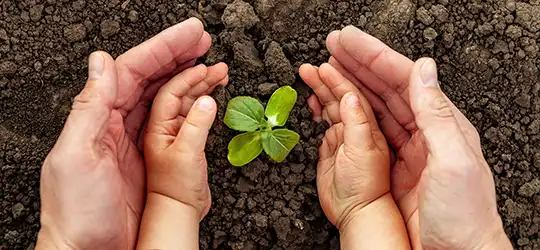
“When enough people come together, then we can achieve almost anything. So, instead of looking for hope, start creating it.” – Greta Thunberg
Since its beginning in 1970, Earth Day continues to grow as more people learn the importance of promoting a healthy, sustainable lifestyle and environment for people and wildlife. Although Earth Day happens once a year, we must accept year-round responsibility for protecting our natural resources, reducing our environmental impact, and making our planet a better place for future generations – the health of our loved ones and neighbors depends on it.
Following in the footsteps of our founding Sisters, the Franciscan Sisters of Mary, we have a long-standing commitment to preserving our earth and its resources and nurturing healthy communities at SSM Health. We understand that environmental damage often impacts those who are most vulnerable, including the poor, sick, and those at the margins of society. As such, we advocate for clean air and water, and neighborhoods in which it is safe to work, play and exercise — as well as limiting our direct negative environmental impact.
As we celebrate Earth Day and Arbor Day during this Year of Hope, let’s come together to find ways to make our environment better and create hope for a greener tomorrow.
Today, we’re focusing on effective ways to recycle.
Did you know that 94% of the natural resources used by Americans are non-renewable – and that recycling saves non-renewable resources?
While natural resources are being depleted, landfills are being filled at an increasing rate. Our current system of production, consumption, and disposal has become unsustainable. It is imperative that we rethink our ideas and our relationship to trash disposal.
Tips for recycling more effectively
1.) No plastic bags: Grocery bags dissolve into potentially harmful microplastics – and they can also be harmful to animals when ingested or when they become entangled. Even though these bags are technically recyclable, you should take them to a drop-off area to recycle them, not your curbside bin. In addition to grocery bags, sandwich bags, bubble wrap, plastic wrapping and other flimsy materials that don’t survive the poke test (where the plastics are soft enough to push your finger through it) are also prime candidates for commercial drop-off areas, not the residential recycling bin.
- Tip: Buy a couple canvas bags and get some reusable containers.
2.) Small things are big problems: If it’s smaller than a credit card, don’t put it in your recycling. Straws, bottle caps, coffee pods, paper clips, and countless other tiny things are too small to be sorted and can jam the recycling equipment. Putting the cap back on a plastic bottle makes it bigger than a business card, so it’s fair game.
- Tip: Be conscious of what you throw into that recycling bin.
3.) Make sure it’s clean, empty, and dry: Food waste can contaminate entire loads of recyclable material, rendering them useless and fast-tracking them to landfills. In the United States, food waste contaminates 25% of our recycling loads.
- Tip: Recycling materials should be clean enough to use again. So, make sure it’s clean, empty, and dry. If your pizza box is covered in cheese and grease, tear off the clean parts of the box and recycle those only.
4.) Combined materials are trash: Recycling only works when like materials are together. Items such as plastic-coated coffee cups, laminated paper, and paper envelopes lined with bubble wrap cannot be separated, so they’re trash.
- Tip: Try to avoid materials than cannot be separated. And when you can, shop local to cut down on the carbon footprint of your products.
5.) Know your plastics: Not all plastics are alike. Rigid plastics are recyclable, labeled by resin codes 1 through 7. Generally, the higher the number, the less recyclable it is. A lot of plastic simply isn’t recyclable curbside. Chip bags, cracker sleeves, cereal bags – if it tears like paper, that can’t be recycled.
- Tip: Check your city’s recycling website for the numbers/codes they will accept.
6.) Don’t “wishcycle”: This is when we optimistically place non-recyclable objects in recycling bins. Good intentions or otherwise, we can contaminate entire loads of otherwise recyclable materials through “wishcycling.”
- Tip: Be conscious of what you are recycling and know if it is accepted or not.
7.) Teach yourself: Knowledge is power. If you’re not certain if something should be recycled, look it up. We all accumulate a lot of stuff throughout our lives — batteries, electronics, paint cans, toys, clothing, wood — and they, unfortunately, all have separate drop off centers or special instructions for recycling.
- Tip: Do your online research. Check out the website of your local recycling hub and teach yourself what you need to know.
There are many things we can do collectively to recycle more effectively: clean our containers better, learn what can be recycled and what can’t. Perhaps most importantly, we can reduce our overall consumption and use. By reducing the amount of trash produced and reusing existing materials, we can all make a difference by protecting the environment, conserving natural resources, and sustaining the planet for future generations.