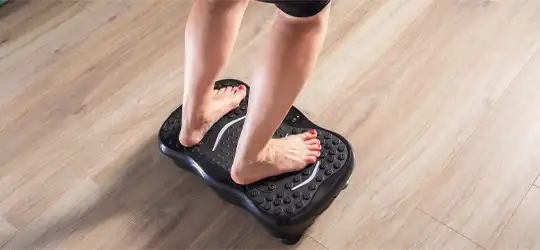
You may have seen one at your local gym or on your social media feed. Maybe you’ve even tried it. Vibration plates are designed to cause quick, involuntary muscle contractions that deliver health and fitness benefits.
And according to wellness coach and SSM Health Family Medicine physician Dr. Roopa Shah, “The concept isn’t new. Vibration therapy can be traced back to the 1800s when a Swedish doctor used it to help people with impairments find some movement.” Question is: Does it work?
Breaking down the claims
Dr. Shah believes that for each of the claims touted by vibration therapy enthusiasts, there may be some small benefit. Still, she added, “Research shows that there are also alternatives that provide much larger benefits for each claim.” The most popular ones include:
Improved blood circulation:
Dr. Shah acknowledges that vibration plates can increase blood flow in a three-minute session. But she reminds us that “anything that activates your muscles can help with this – including simple exercising.”
Better recovery from exercise:
“Improved circulation from a vibration plate does support muscle recovery,” she said. “It can boost the impact of your stretching routine, which can help with muscle tightness and soreness post-workout.” Still, the benefits may be marginal and can be achieved through less costly tools like foam rollers, compression sleeves, or even just stretching.
Improved balance:
According to Dr. Shah, “Working on an unstable surface does improve our balance and stability. So, there is some promise here – but there isn’t enough research to know how beneficial vibration plates are for this.” You can also achieve better balance and stability through simple daily exercises like single leg stands and walking heel to toe.
Increased bone density:
“Researchers think vibration therapy might have a modest impact,” said Dr. Shah. “But so far the research isn’t clear on how much benefit the therapy provides or what is the recommended effective dose for improvement.” She adds that “activities like running and strength training would probably yield better results.”
Weight loss:
When it comes to weight loss, the results are not very promising from a research perspective. Dr. Shah noted, “Some people reported losing modest weight – about two to four pounds – using a vibration plate. But the amount isn’t enough to change the ratio of their body fat to the rest of their body – indicating it’s not a great tool for weight loss by itself.” You’ll likely need diet and other forms of exercise for meaningful weight loss.
When to consider vibration plates
Dr. Shah says that if vibration plates are the most accessible tools available, they could be helpful. “But there’s not a lot of science to support buying one,” she added. “And it’s important to know that high-intensity or prolonged use can make existing conditions like osteoporosis, heart conditions, or inner ear problems worse.
“Vibration plates can also cause dizziness and headaches,” she noted. “If you start using a vibration plate, start slow at a low intensity and increase gradually. If you start to feel pain, numbness, or dizziness, stop using it.”
An athlete at any level can experience a sports-related injury that benefits from specialized care. SSM Health’s sports medicine team can evaluate and provide treatment options to help you heal and return to the activities you love.