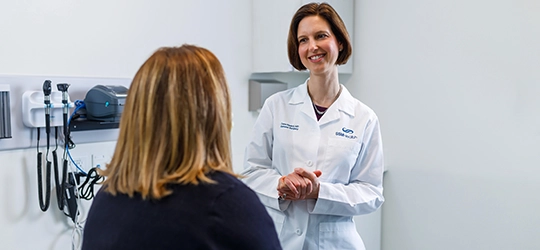
After her daughter was diagnosed with breast cancer at age 38, Susan Greene decided it was time to be more proactive about her own breast health. “My sister is also a breast cancer survivor. I have dense breasts and wanted to discuss any other screenings that I should have based on that history,” she explained. So, Greene, a women’s health nurse practitioner at SSM Health in Madison, asked for a referral to the High-Risk Breast Clinic.
Overall, breast cancer affects one out of every eight women in the United States. But for women like Greene, the risk is actually much higher. Cancer rates can range from nearly 1 in 4 for those with a first-degree family history, and up to 7 in 10 for women with certain genetic predispositions. 1
For these women, increased diligence can make all the difference, physically and emotionally. Since 2020, a specialized team in Madison, Wisconsin, has been offering just that. SSM Health’s High-Risk Breast Clinic sees women with a personal or family history of breast cancer and those with dense breasts and/or breast pain.
According to the clinic’s Dana Henkel, MD, “We want to be proactive about it and get people in. We will be screening them, risk stratifying them, and doing all the imaging that might be needed along with any counseling that they need.”
Identifying risk and recommendations
During the initial visit, a complete history will be taken to identify any and all risks. “We talk about any breast concerns they may have. We talk about family history with details about diagnosis, age of that family member, and other cancers such as ovarian cancer,” said clinic physician assistant, Holly Ludden.
Breast density, reproductive history, and lifestyle factors will be discussed as well. “And then we'll do that risk calculation together,” Ludden added. The clinic uses the IBIS Risk Assessment Tool to estimate a woman’s 10-year and lifetime risk of developing breast cancer. That information is used to create a personalized plan based on National Comprehensive Cancer Network recommendations.
“That plan may include more imaging. It may include genetic testing. It may include medications that can help decrease their risk,” added Dr. Henkel. Often, women at high risk are screened with both annual mammograms and annual breast MRIs. They alternate one form of imaging every six months.
“And then there are the modifiable risk factors. So, we're thinking about your weight and how much you exercise. Drinking alcohol and smoking increases cancer risk. There are different dietary and environmental issues that we certainly can modify,” said Dr. Henkel.
As Greene confirmed, “The appointments are longer and give patients the time to ask questions without feeling rushed. This gave me time to ask all the questions I needed.”
Focused on ongoing, comprehensive care
At the High-Risk Breast Clinic, care doesn’t begin and end with a recommendation. Patients receive all breast-related care through the clinic. According to Dr. Henkel, “The clinic provides screening and diagnostic mammograms, breast MRIs, and diagnostic ultrasounds. Our team of breast surgeons and interventional radiologists can also perform breast biopsies, punch biopsies, and aspirations when needed.”
The team also includes breast radiology nurse navigators and a breast cancer nurse navigator. These specialists assist patients with biopsy results and getting imaging ordered and appointments scheduled.
The clinic goes beyond simply meeting the physical needs of their patients. As Dr. Henkel explained, “The emotional side of breast cancer is a lot. And we see this every day, especially when you are diagnosed with breast cancer.
“But if you even have cancer in your family, you feel like you're just kind of waiting for that to happen to you. We're going to be proactive and think about ways to support those emotional needs.” That may include sending a patient for genetic testing or ordering an MRI to provide added peace of mind to a worried patient. Whatever it takes.
“The clinic is wonderful,” said Greene. “They recommended a full screening that tested 77 genes, plus an RNA analysis and a breast MRI,” she said.
Accessing the clinic
“To schedule an appointment at the High-Risk Breast Clinic, a patient just needs to talk to their primary care provider who can easily put in a referral,” said Dr. Henkel.
Ludden added, “Whether it's family history, dense breast tissue, or a combination of any of that with hormone replacement therapy, we're happy to see those patients, calculate their risk, and go from there.”
The High-Risk Breast Clinic is located on the first floor of the SSM Health Outpatient Center on the campus of SSM Health St. Mary’s Hospital - Madison. Get directions to the High-Risk Breast Clinic.
Learn more about the comprehensive breast health services offered by SSM Health.