During their 20 week anatomy scan, Kasee and David learned their unborn son had a rare and serious congenital heart condition. Baby Easton was diagnosed with Hypoplastic Right Heart Syndrome (HRHS) and Tricuspid Atresia -- defects where the right side of the heart, especially the right ventricle and tricuspid valve, do not develop properly. Because the heart cannot pump blood to the lungs effectively, the body does not receive enough oxygenated blood.
“I lost it,” Kasee remembered. “I just sat and cried. I couldn’t speak. I didn’t even know what questions to ask.”
The rest of her pregnancy became very high risk, requiring weekly appointments, stress tests, and ultrasounds at the St. Louis Fetal Care Institute and the Dorothy and Larry Dallas Heart Center at SSM Health Cardinal Glennon Children’s Hospital. HRHS has no cure, but children often undergo a three stage series of surgeries to reroute blood flow so the left ventricle can compensate for the underdeveloped right side. Kasee, who had her own heart surgery at Cardinal Glennon as a baby, felt reassured. “I knew we were in the right place.”
Despite a smooth delivery and a healthy birth weight of 9 pounds 9 ounces at SSM Health St. Mary’s Hospital - St. Louis, Easton needed immediate intervention. He was transported by ambulance to the Level IV NICU at SSM Health Cardinal Glennon. David followed the ambulance, then returned to bring Kasee who discharged herself early so she could be with Easton.
Those first days were filled with everything except the usual joys of holding a newborn. “There were breathing tubes, feeding tubes, central lines, echocardiograms, and so many tests -- things I never had to learn with my other two children,” Kasee said. At only eight days old, Easton underwent his first open heart surgery, the Norwood procedure. Although he initially did well, complications soon followed.
One night, at 3 a.m., doctors from Cardinal Glennon called while Kasee and David were home caring for their older children. Easton had gone into cardiac arrest and was placed on ECMO, a machine that temporarily replaces the functions of the heart and lungs. They were told to return immediately and warned they might be coming to say goodbye. Easton had been without oxygen for 7–10 minutes, causing neurological injury to a small part of his brain. He remained on ECMO for more than a week. Slowly, miraculously, he improved and was eventually able to go home.
On July 1, 2021, Easton had his second open heart surgery, the Glenn procedure. He recovered quickly, going home in just three days. For the next two years, he stayed healthy and was able to enjoy being a kid.
Just before New Year’s Eve 2024, Easton became sick with walking pneumonia and RSV. Soon afterward, his oxygen levels dropped, and an ambulance brought him back to Cardinal Glennon. Tests showed his heart was no longer functioning properly. As medications failed, doctors determined he was too sick for his third planned surgery and placed him on the list for a heart transplant.
On February 12, 2025, Easton went into cardiac arrest four to five times and was placed on ECMO again. His family had him baptized. The next day, surgeons attempted his third open heart surgery, the Fontan procedure, and implanted a Ventricular Assist Device (VAD) to support him while he awaited a transplant. Easton remained in the PICU for months, enduring countless ups and downs while continuing to fight with incredible resilience.
With the family living in Foley, Missouri, life became complicated. David took a job in Cardinal Glennon’s security department. Kasee’s sister cared for their older children Jackson, 12, and Charleigh, 7 while Kasee and David lived at the Mid America Transplant Family House. On weekends, the older kids visited, keeping the family connected. Meanwhile, Easton found moments of joy: music therapy, daily visits from his Child Life Specialist, Alyssa, and physical and occupational therapy sessions that helped him stay active.
Then, on the morning of September 8, 2025, at 8:51 a.m., Kasee received the call they had waited for: a donor heart was available. Easton had been listed for 465 days, lived with his Berlin Heart for 204 days, and been hospitalized for over 243 days.
His transplant took place on September 10. Surgeons Charles Huddleston, MD, Corinne Tan, MD, Andrew Fiore, MD, and Peter Pastuszko, MD worked for over 10 hours. “It was such a long, emotional day, but everything went as smoothly as it could,” Kasee said. Easton was extubated the next day, spent only a week in the PICU, and moved to the Transitional Care Unit on September 16.
After working hard in therapy, regaining his appetite, and undergoing a successful biopsy, Easton was discharged on September 29. And after more recovery at the Transplant Family House, he finally returned home to rejoin his big brother and sister, bringing his long, courageous journey full circle.
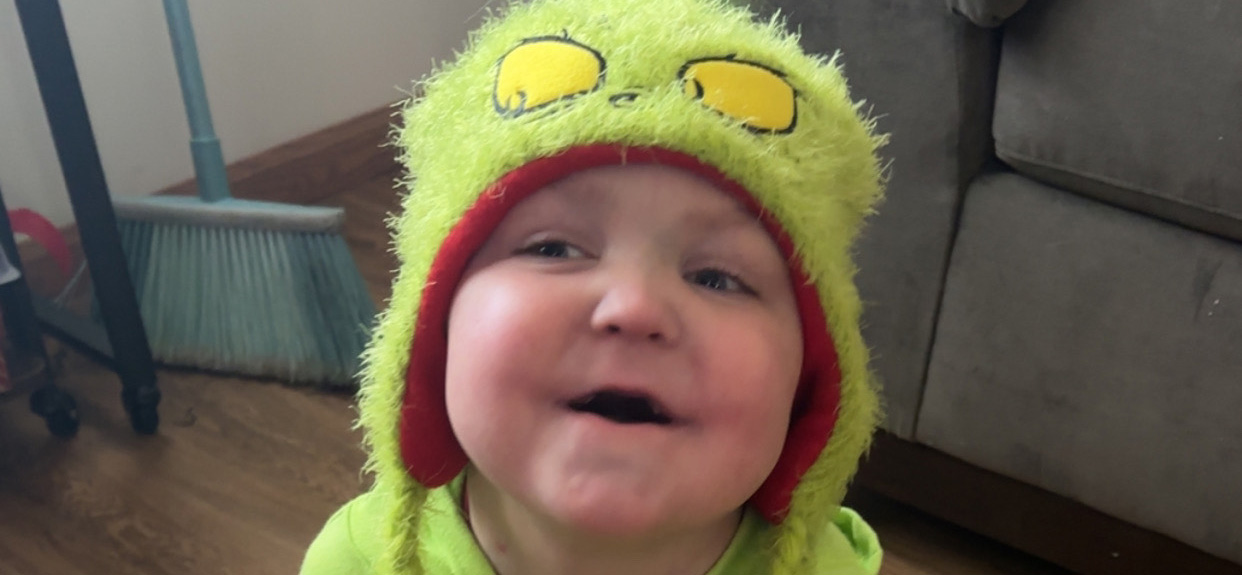
Kasee says Easton loves being home and keeping up with his big brother and big sister. Easton’s Dad is still his best friend.
Overall, she says, Easton is doing amazingly well. “He’s off a few meds now. He’s walking a lot now without assistance at all and is starting to use his right arm a little more. He loves to eat, and is always smiling… like, always!”