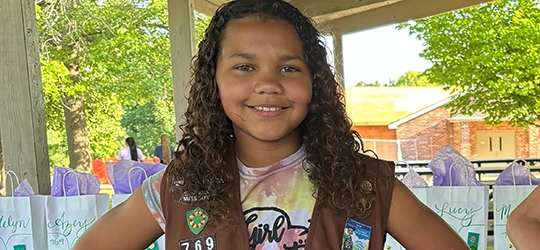
In 2025, Sadie Ewing’s summer was filled with joyful childhood activities — swimming, volleyball camp, sleepovers with friends, going out to dinner with family members and earning badges for participation in outdoor Girl Scouts activities.
“I was just being a normal kid,” the 10-year-old says with a huge laugh.
Tennis and wrestling were still on her to-do list this fall even as she tackled challenging classes in the Spectra gifted program in the Francis Howell School District in Weldon Spring, MO. “I’ve built rockets and done all sorts of things in the program,” she says. “It keeps me on my toes!”
The whirlwind of school and fun is a true about-face from early 2024 when Sadie was so hampered by gastrointestinal motility issues that she often headed home from school early, left birthday parties, was unable to play sports and worried about being able to spend long hours with friends.
“I couldn’t tell if I was going to have a problem or not,” she says. “It was kind of awful.”
Sadie was worried about something that impacts a significant number of children each year: chronic constipation that often leads to emergency trips to the bathroom whenever a child is given laxatives.
“She had the problem ever since she was a baby,” says Sadie’s mother, Lisha Ewing. “She had difficulty pooping, and we could tell it was painful. We tried different formulas, and Sadie was tested for a milk allergy and then given an over-the-counter laxative to see if it would get better.”
But the problem continued for several years until Sadie was referred to Pediatric Gastroenterologist Fernando Medina Carbonell, MD, at SSM Health Cardinal Glennon Children’s Hospital. He referred the family to Dhiren Patel, MD, director of the Neuro-gastroenterology and Pediatric Motility Center. It is one of just a few centers in the country dedicated to diagnosing and treating various motility disorders and diseases of gut-brain interaction (DGBI) in young children and adolescents through nonsurgical interventions.
New combined GI and Surgery clinic opens
“What we needed was an extension of our Motility Center that would also include surgical interventions when they were warranted,” says Dr. Patel. “This year, SSM Health Cardinal Glennon opened the region’s first pediatric Colorectal and Pelvic Reconstruction Program. It includes both gastroenterologists and pediatric surgery specialists who coordinate and treat patients with colorectal and pelvic conditions that also present with impaired gut motility.”
Dr. Patel runs the new program with Co-director and Pediatric General Surgeon Shin Miyata, MD. “The benefits are two-fold,” stresses Dr. Miyata. “We have created a one-stop clinic visit where patients and families can learn about diagnostic testing as well as medical and surgical interventions all in one visit. Then Dr. Patel and I discuss various treatment options and go over next steps with the families.”
The program already is seeing patients diagnosed with Hirschsprung disease, anorectal malformations, inflammatory bowel disease, severe constipation and fecal incontinence. All undergo advanced testing, including manometry, a specialized procedure that allows doctors to assess muscle function from the esophagus to the rectum. If surgery is recommended, it can range from minimally invasive to reconstructive procedures.
ACE-ing the problem of severe constipation
For Sadie, the two doctors recommended a novel device called a MiniACE (antigrade continence enema). “Think of it as an enema given from the top down versus going up through the rectum,” explains Dr. Miyata. “It is easier on the patient and is more predictable and controllable. There’s nothing ‘magical’ about it except that we can give an enema more upstream in the gastrointestinal system, but patients say there is a night and day difference in the quality of their lives and in their ability to control constipation and fecal incontinence.”
The minimally invasive procedure involves creating a tunnel or pathway from the belly button to the colon. It creates an external hole at the belly button into which Dr. Miyata places a “button,” or one-way valve. Patients can then “flush” out the colon by injecting certain fluids through the button. “I put my medicine in a clear bag, shake it and put it in my ACE button,” says Sadie matter-of-factly. “Then I set a timer and go sit in the bathroom to poop. It works every time.”
Both Sad routine for Sadie to handle on her own. Now it’s working so well that Dr. Patel recently reduced the number of times she needed to do a flush from nightly to five days a week. The goal is to continue stepping down the number of flushes in hope that Sadie’s system will return to normal. No more constipation; no more being worried about laxatives kicking in at inappropriate times.
Dr. Miyata says a major plus with the ACE button is that it is reversible if the colon begins to recover and work on its own. “We can easily take out the button, and the exterior hole will close on its own,” he says.
Ewing says her daughter is now a “social butterfly” and has received friendship awards at school. She also was able to go on an all-day train trip and tour of the Missouri State Capital in Jefferson City to earn a Girl Scouts badge.
“Life-changing? Absolutely,” says Ewing. “Sadie is enjoying school and not missing out on fun events. This has made such a huge difference in our lives.”
This story was featured in the 2025 issue of Glennon Magazine.