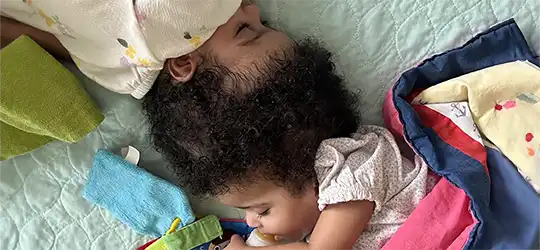
Loralee was diagnosed with Gastroschisis before she was born. Megan and Jared met in 2003, wed in 2008, and started planning their family in 2010.
“We wanted a spring 2011 baby and, sure enough, we found out that I was expecting in August 2010,” writes Megan, who lives in southeast Missouri. “The newest member of our family would have a due date of April 4, 2011 — all of our well-laid plans were falling into place.”
In November 2010, Megan headed to her ultrasound appointment, hoping to find out whether her first child with husband Jared would be a boy or a girl. Instead, they discovered that their unborn child had a condition known as Gastroschisis, a condition that occurs early in a pregnancy when the baby’s abdominal wall muscles do not form properly. It causes abdominal organs, such as the intestines and gonads, to protrude outside of the abdominal wall just to the right of the belly button.
“So much for well-laid plans,” writes Megan. “I didn’t cry until after the doctor left the room, and even then only a few tears fell."
“I understand that every pregnancy is different, every person is different, and I couldn’t stress about it. Stress isn’t good for me or my baby. My job as ‘pregnant mommy’ was to be healthy and positive and to give my baby the best first 9 months that I possibly could. So I sucked it up and smiled … eventually.”
Megan says her obstetrician immediately put her and her husband in contact with the team of doctors and nurses at SSM Health St. Louis Fetal Care Institute, and she began regular appointments there right away. In the 18 weeks between finding out about the Gastroschisis and delivery, Megan had 16 appointments between her regular OB in Sikeston and the team at the St. Louis Fetal Care Institute, including an ultrasound that finally confirmed they would be having a daughter, to be named Loralee!
About 2,000 babies are born with Gastroschisis each year in the United States. During the pregnancy, babies with Gastroschisis are monitored through regular ultrasounds to watch for possible intestinal complications, and monitor the baby’s growth. The goal is to monitor the baby for any additional problems and to help the baby reach an optimal delivery date.
Writes Megan: “Loralee was perfectly healthy throughout the pregnancy. She was a small baby, but the doctors weren’t worried about that. In addition to Loralee’s size and approximate weight, the size of the opening where her intestines were protruding, the size of her stomach, and every other measurement you could possibly imagine, the doctors also watched her heart and her brain development closely.”
In early 2011, Megan had an MRI scan to get better imaging of Loralee after ultrasounds revealed possible abnormalities in her baby’s brain development. While preliminary images indicated the baby might be missing her corpus callosum (the piece that connects left and right brain), additional screenings showed that, while that piece is there, she was missing her septum pellucidum (a thin membrane located at the midline of the brain between the two cerebral hemispheres, or halves of the brain). The complications of this condition — which can include developmental defects in the eyes — would not be known until after Loralee’s birth.
To cope with this difficult set of circumstances, Megan says she focused on staying as active as possible, for as long as possible, focusing on sharing positive news, and staying away from the Internet. She says she avoided stress by only researching Loralee’s condition after she was convinced her daughter would be okay and that she was in the absolute best care possible.
“Stay strong, physically and mentally,” Megan writes. “Remember that you’re in wonderful hands at the Fetal Care Institute. The amazing doctors and nurses will give you all the information you need to know, but don’t dwell on the negative possibilities. Stay positive and learn to smile.”
Megan has plenty to smile about these days. Her daughter, Loralee Grace, was born March 16, 2011, weighing just 5 lbs. 3 oz. Her road to recovery was “remarkably smooth,” according to Megan, requiring just 24 days in the Cardinal Glennon NICU. In the summer of 2016, Loralee was getting ready for kindergarten after passing her entrance screening with an IQ of 142 (or very superior)!
“She loves to sing and dance and play with her friends and cousins,” Megan writes of her daughter. “She has an active imagination and believes she is a mermaid (her tail will only form when she’s in the magic waters). She’s still small, but no one is worried about that. She’s tough, sensitive, smart, thoughtful, an athlete and an entertainer.”
Megan’s advice to other moms facing a similar situation? Keep a diary.
“Everyone’s experience is going to be completely unique. This was Loralee’s story. You’ll want to remember the details of your own story.”
“We wanted a spring 2011 baby and, sure enough, we found out that I was expecting in August 2010,” writes Megan, who lives in southeast Missouri. “The newest member of our family would have a due date of April 4, 2011 — all of our well-laid plans were falling into place.”
In November 2010, Megan headed to her ultrasound appointment, hoping to find out whether her first child with husband Jared would be a boy or a girl. Instead, they discovered that their unborn child had a condition known as Gastroschisis, a condition that occurs early in a pregnancy when the baby’s abdominal wall muscles do not form properly. It causes abdominal organs, such as the intestines and gonads, to protrude outside of the abdominal wall just to the right of the belly button.
“So much for well-laid plans,” writes Megan. “I didn’t cry until after the doctor left the room, and even then only a few tears fell."
“I understand that every pregnancy is different, every person is different, and I couldn’t stress about it. Stress isn’t good for me or my baby. My job as ‘pregnant mommy’ was to be healthy and positive and to give my baby the best first 9 months that I possibly could. So I sucked it up and smiled … eventually.”
Megan says her obstetrician immediately put her and her husband in contact with the team of doctors and nurses at SSM Health St. Louis Fetal Care Institute, and she began regular appointments there right away. In the 18 weeks between finding out about the Gastroschisis and delivery, Megan had 16 appointments between her regular OB in Sikeston and the team at the St. Louis Fetal Care Institute, including an ultrasound that finally confirmed they would be having a daughter, to be named Loralee!
About 2,000 babies are born with Gastroschisis each year in the United States. During the pregnancy, babies with Gastroschisis are monitored through regular ultrasounds to watch for possible intestinal complications, and monitor the baby’s growth. The goal is to monitor the baby for any additional problems and to help the baby reach an optimal delivery date.
Writes Megan: “Loralee was perfectly healthy throughout the pregnancy. She was a small baby, but the doctors weren’t worried about that. In addition to Loralee’s size and approximate weight, the size of the opening where her intestines were protruding, the size of her stomach, and every other measurement you could possibly imagine, the doctors also watched her heart and her brain development closely.”
In early 2011, Megan had an MRI scan to get better imaging of Loralee after ultrasounds revealed possible abnormalities in her baby’s brain development. While preliminary images indicated the baby might be missing her corpus callosum (the piece that connects left and right brain), additional screenings showed that, while that piece is there, she was missing her septum pellucidum (a thin membrane located at the midline of the brain between the two cerebral hemispheres, or halves of the brain). The complications of this condition — which can include developmental defects in the eyes — would not be known until after Loralee’s birth.
To cope with this difficult set of circumstances, Megan says she focused on staying as active as possible, for as long as possible, focusing on sharing positive news, and staying away from the Internet. She says she avoided stress by only researching Loralee’s condition after she was convinced her daughter would be okay and that she was in the absolute best care possible.
“Stay strong, physically and mentally,” Megan writes. “Remember that you’re in wonderful hands at the Fetal Care Institute. The amazing doctors and nurses will give you all the information you need to know, but don’t dwell on the negative possibilities. Stay positive and learn to smile.”
Megan has plenty to smile about these days. Her daughter, Loralee Grace, was born March 16, 2011, weighing just 5 lbs. 3 oz. Her road to recovery was “remarkably smooth,” according to Megan, requiring just 24 days in the Cardinal Glennon NICU. In the summer of 2016, Loralee was getting ready for kindergarten after passing her entrance screening with an IQ of 142 (or very superior)!
“She loves to sing and dance and play with her friends and cousins,” Megan writes of her daughter. “She has an active imagination and believes she is a mermaid (her tail will only form when she’s in the magic waters). She’s still small, but no one is worried about that. She’s tough, sensitive, smart, thoughtful, an athlete and an entertainer.”
Megan’s advice to other moms facing a similar situation? Keep a diary.
“Everyone’s experience is going to be completely unique. This was Loralee’s story. You’ll want to remember the details of your own story.”