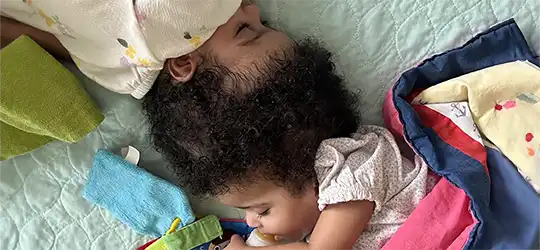
Laura and Ryan, who met in college at SIUE, found out they were expecting their first child on Thanksgiving of 2012. At a routine ultrasound, they found out their baby had pleural effusions – fluid around her lungs. After several doctor's office visits, and very few answers, the couple was referred to the SSM St. Louis Fetal Care Institute.
At 24-weeks into her pregnancy, the couple visited the Fetal Care Institute and were told Lucie had Congenital Diaphragmatic Hernia (CDH), which was causing her intestines to migrate into her chest. At 25 weeks, Laura had a (MRI) magnetic resonance imaging test to confirm the diagnosis and provide more information about Lucie to the Fetal Care Institute team.
CDH is a fetal abnormality that occurs very early in pregnancy (10-12 weeks), when the baby’s diaphragm does not form properly. An opening in the diaphragm leads to contents of the abdomen—such as the stomach, small intestine, spleen, liver, or kidney—developing in the chest cavity instead of the abdomen. The displaced organs prevent the lungs from developing properly.
She and her husband were very scared, facing a 50-percent chance their daughter wouldn’t survive. Because there is no fetal surgeries available for CDH, their biweekly treatment plan was to monitor the amount of intestine in Lucie’s chest, as well as the fluid around her lungs, and prepare for delivery.
Right after Laura and Ryan received Lucie’s diagnosis, the Fetal Care Institute was hosting the Parade of Cherubs. This special event brings together families who have had a child with CDH. At the parade, the couple met a mom who had lost her son to CDH. She connected them to several families who had children with the condition.
One couple they met had their baby two weeks prior to Lucie being born. The two couples were able to support each other throughout the pregnancy and births. “It was so nice to have someone who understood what we were talking about and knew the emotions we were feeling.,” says Laura.
As Laura approached the end of her pregnancy Lucie developed hydrops, which can lead to heart failure, and Laura was diagnosed with polyhydramnios, an excessive accumulation of amniotic fluid that can cause preterm labor. So, they were both monitored twice a week until Laura was hospitalized at 35 weeks.
CDH babies can face many medical challenges when they are born, so it is best for them to be delivered at a medical center where there is immediate access to a team of pediatric surgeons and neonatologists, along with an established NICU (Neonatal Intensive Care Unit). Because Lucie had CDH, pleural effusions and hydrops, it was determined that the best delivery plan for her would be a cesarean section at SSM Cardinal Glennon Children's Medical Center.
At 37 weeks Lucie made her entrance to the world. Laura and Ryan were forewarned there was a good chance that Lucie wouldn’t cry upon her birth, but she gave out two good wails before the team of neonatologists determined that a breathing tube and ventilator were needed to help her breathe. When Lucie was 10 days old she had the surgery to repair the hole in her diaphragm. Twelve days later Lucie went home from the NICU without any support.
Despite the challenges toward the end, Laura said her pregnancy was relatively easy. “Even with polyhydramnios, it wasn’t bad. I really enjoyed feeling Lucie moving around – she had plenty of room to move around so she did,” Laura says.
Through Laura and Ryan's journey, they discovered a charity called CHERUBS that provides support for families expecting CDH babies. “It was amazing to know that so many people understood your anxieties and survived. I also found our nurse Jenny and our Footprints coordinator Kathy especially supportive,” Laura says. Footprints is a program at SSM Cardinal Glennon Children’s Medical Center that is committed to improving the quality of life for children living with complex medical illnesses and their families. They offer care coordination that addresses not only the physical needs of a child but the emotional, spiritual and psychosocial needs of the family as well.
Laura and Ryan learned a lot from their journey. “First of all, we learned to go with the flow. We never knew what was going to happen or how things would turn out. Life in the NICU is a minute-by-minute experience. We also learned to appreciate every moment because you never know when it could all end,” recalls Laura.
She also advises any expecting family not to lose faith, commenting, “These babies continuously prove they're super heroes and we can take a lesson from them.”
At 24-weeks into her pregnancy, the couple visited the Fetal Care Institute and were told Lucie had Congenital Diaphragmatic Hernia (CDH), which was causing her intestines to migrate into her chest. At 25 weeks, Laura had a (MRI) magnetic resonance imaging test to confirm the diagnosis and provide more information about Lucie to the Fetal Care Institute team.
CDH is a fetal abnormality that occurs very early in pregnancy (10-12 weeks), when the baby’s diaphragm does not form properly. An opening in the diaphragm leads to contents of the abdomen—such as the stomach, small intestine, spleen, liver, or kidney—developing in the chest cavity instead of the abdomen. The displaced organs prevent the lungs from developing properly.
She and her husband were very scared, facing a 50-percent chance their daughter wouldn’t survive. Because there is no fetal surgeries available for CDH, their biweekly treatment plan was to monitor the amount of intestine in Lucie’s chest, as well as the fluid around her lungs, and prepare for delivery.
Right after Laura and Ryan received Lucie’s diagnosis, the Fetal Care Institute was hosting the Parade of Cherubs. This special event brings together families who have had a child with CDH. At the parade, the couple met a mom who had lost her son to CDH. She connected them to several families who had children with the condition.
One couple they met had their baby two weeks prior to Lucie being born. The two couples were able to support each other throughout the pregnancy and births. “It was so nice to have someone who understood what we were talking about and knew the emotions we were feeling.,” says Laura.
As Laura approached the end of her pregnancy Lucie developed hydrops, which can lead to heart failure, and Laura was diagnosed with polyhydramnios, an excessive accumulation of amniotic fluid that can cause preterm labor. So, they were both monitored twice a week until Laura was hospitalized at 35 weeks.
CDH babies can face many medical challenges when they are born, so it is best for them to be delivered at a medical center where there is immediate access to a team of pediatric surgeons and neonatologists, along with an established NICU (Neonatal Intensive Care Unit). Because Lucie had CDH, pleural effusions and hydrops, it was determined that the best delivery plan for her would be a cesarean section at SSM Cardinal Glennon Children's Medical Center.
At 37 weeks Lucie made her entrance to the world. Laura and Ryan were forewarned there was a good chance that Lucie wouldn’t cry upon her birth, but she gave out two good wails before the team of neonatologists determined that a breathing tube and ventilator were needed to help her breathe. When Lucie was 10 days old she had the surgery to repair the hole in her diaphragm. Twelve days later Lucie went home from the NICU without any support.
Despite the challenges toward the end, Laura said her pregnancy was relatively easy. “Even with polyhydramnios, it wasn’t bad. I really enjoyed feeling Lucie moving around – she had plenty of room to move around so she did,” Laura says.
Through Laura and Ryan's journey, they discovered a charity called CHERUBS that provides support for families expecting CDH babies. “It was amazing to know that so many people understood your anxieties and survived. I also found our nurse Jenny and our Footprints coordinator Kathy especially supportive,” Laura says. Footprints is a program at SSM Cardinal Glennon Children’s Medical Center that is committed to improving the quality of life for children living with complex medical illnesses and their families. They offer care coordination that addresses not only the physical needs of a child but the emotional, spiritual and psychosocial needs of the family as well.
Laura and Ryan learned a lot from their journey. “First of all, we learned to go with the flow. We never knew what was going to happen or how things would turn out. Life in the NICU is a minute-by-minute experience. We also learned to appreciate every moment because you never know when it could all end,” recalls Laura.
She also advises any expecting family not to lose faith, commenting, “These babies continuously prove they're super heroes and we can take a lesson from them.”