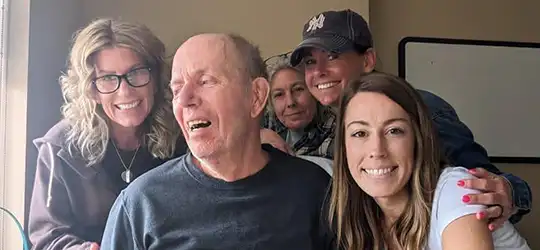
This story is part of an ongoing series on age-friendly care, a national movement to improve healthcare for older adults by ensuring their needs and preferences are considered in all aspects of care. SSM Health believes in the 4Ms of age-friendly care: What matters, medication, mentation and mobility.
At 56, Randy Beeman was experiencing one of the best chapters of his life. He was a grandfather enjoying his five grandchildren and his carpentry business was booming.
“My dad was a good man, and he was really thriving at that time,” said Beeman’s daughter, Kaitlyn Overman.
But in 2018, his family noticed a big shift in his personality. He withdrew from people and moved into his mother’s vacant house after she went to a skilled nursing facility even though he had a home and a wife. He stopped answering the phone and went into almost total seclusion both personally and professionally.
“He quit the business he built and worked for over 20 years. Just up and walked away from it,” said Overman. “He was very secretive about it until my mom found out that he had cancelled all his jobs he had lined up with customers. His personal hygiene also decreased significantly. He stopped wanting to take showers and brush his teeth. Again, very opposite of who he normally was.”
That was the beginning of a long and difficult seven-year journey searching for answers.
A misdiagnosis and a missing-person report
Beeman’s family knew he needed to get to a doctor, and by this time he knew it too. Their frustration continued when the initial diagnosis was one they did not believe was accurate – bipolar disorder. He was prescribed lithium, a powerful mood-stabilizing drug, but his behavior continued to worsen.
“He stopped sleeping at night. He'd wander around and have obsessive behavior. Like one time he swept the porch for an extremely long time, just sweeping in a circle,” remembered Overman. “Wandering around became a huge issue for his safety. He would walk a busy highway miles and miles into town by himself. He would get into neighbors' sheds and belongings. We had to report him missing one night in January. It was one of the coldest nights of the year and he just left. The police had the search dogs out looking for him and tried to ping his cell phone. It was terrifying. We ended up finding him in the neighbor's basement. He crawled through their basement window and fell asleep. It was heartbreaking and horrifying, to say the least.”
It would not be the last time the police would get involved. Things would get worse before a diagnosis would come for Beeman, a man of faith who read the Bible most of the days of his life.
The event that led him to SSM Health in Madison, Wisconsin
“He got arrested for stealing a slushie,” said Overman. “This was not my dad. Everyone loved him. Even the police officers loved him, but it turned out to be a blessing because he had a seizure while in custody and was taken to St. Mary’s.”
Beeman stayed at SSM Health St. Mary’s Hospital - Madison for a total of seven months over two separate stays. He and his family learned he had a bacteria growing in his brain. The bacteria, known as a mycobacterium, is very rare and how he got it remains a mystery. Beeman was an outdoorsman. Could it come from something in the soil or wetlands? No one knows, but getting the diagnosis and having a care team is what his daughter says he needed.
“The pieces kind of shattered gently once the team came into place. It was a turning point.”
After years of not knowing why his behavior changed so dramatically, or the cause of his seizures, Beeman and his family had an answer.
“To try to treat the bacteria, they put my dad on very aggressive antibiotics via a PICC line for six weeks,” said Overman.
A PICC line, or peripherally inserted central catheter, is a thin, flexible tube inserted into a vein in the upper arm that extends into a larger central vein near the heart. It allows long-term intravenous access and delivery of medications, fluids, or blood products, and also provides access for blood draws, without frequent needle sticks.
Jennifer Zinkle manages the neurosciences and trauma unit at SSM Health St. Mary’s Hospital in Madison, Wisconsin, where hospital staff utilized three of the 4Ms of age-friendly care – mentation, mobility and what matters – to ensure Beeman received the care he needed.
Addressing his mental health, also known as mentation

“He was the happiest patient,” said Zinkle. “He smiled all the time and made artwork out of cups or anything else that was available. We all got very attached to him and spent extra time with him and brought him arts and crafts projects so that he would have something to do.”
Beeman’s daughter says that bond with St. Mary’s Hospital staff was a blessing.
“We never had to worry,” said Overman. “The staff was so sweet to him. They loved him and he loved them back. They truly became family for my dad.”
Promoting mobility
In addition to keeping his mind occupied with art projects, his care team worked to keep him mobile.
“My dad loved chocolate. They would walk him to Jen’s office where she had a chocolate jar,” laughed Overman. “Being his family, it meant a lot to us that they treated him not just as a patient but to make sure he got what he needed. They knew exactly what he needed when he had a seizure and comforted him afterward.”
Learning what matters most to the patient
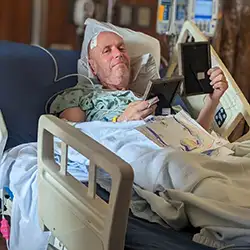
When the antibiotics did not work, the bacteria continued to attack his brain and Beeman received news that his illness was terminal. The staff learned that what mattered most to Beeman was being closer to his family so they could visit more often and spend more time with him.
“He was not from the Madison area and his family worked during the week so they could only come on weekends,” Zinkle said. “He was lonely and really wanted to be closer to his family so we worked to get him to a place that would take care of him closer to the people he loves.”
Today, Beeman is at a nursing home in his hometown where he gets frequent visits from his wife, children and grandchildren. His daughter still sends St. Mary’s Hospital staff photos to show them how he is doing.
“He still cries when he thinks about them,” she said.
What are the 4Ms?
What Matters:
Understanding the patient's values, goals, and preferences, and incorporating them into the care plan.
Medication:
Reviewing and optimizing medication regimens to ensure they are safe and effective for older adults.
Mentation:
Addressing cognitive issues like dementia, delirium, and depression, and providing appropriate support.
Mobility
Promoting physical activity and addressing mobility limitations to help older adults maintain their independence.