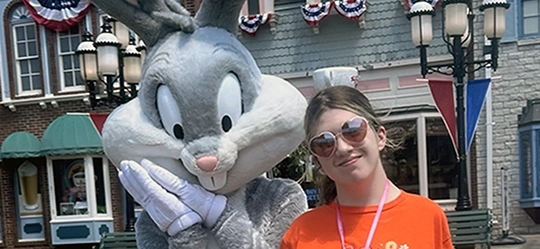
Lyndsey Firle walked into Six Flags St. Louis with a smile on her face and a mission to accomplish — to ride a roller coaster. The River King Mine Train had been a long-time favorite and one she thought she might never be able to ride again.
“She’s a typical teenager in that she likes to play games and swim, but the roller coaster was a big step forward after dealing with so many health issues,” said Lyndsey’s mother, Michelle. “She was so excited to be able to ride!”
Lyndsey was diagnosed in utero with hypoplastic left heart syndrome, a congenital defect that results in the left side of the heart being underdeveloped and not able to pump blood effectively. Her first open-heart surgery was when she was just three days old. Health problems persisted, however, and Lyndsey had a brain aneurysm and two strokes by the time she was three years old. By age 4, she’d undergone three heart surgeries and was diagnosed with cerebral palsy.
“She kept bouncing back,” said Michelle. “We were initially told she might not walk, but she did therapy and walked right on target when any child should.”
As Lyndsey grew up and went to school, her parents noticed one day that she was leaning significantly. Doctors determined that Lyndsey had scoliosis, an abnormal curvature of the spine. Bracing was recommended as a first step.
“Scoliosis is very common in patients with cerebral palsy,” said pediatric orthopedic surgeon Dustin Baker, MD. “Up to 20 percent of children with cerebral palsy develop abnormal curves in their spines.”
When Lyndsey underwent a rapid growth spurt during her adolescent years, her scoliosis progressed despite bracing. Her spine was curving abnormally left to right in an “s” curve as well as front to back, creating a rounded back. “When Dr. Baker showed us the curvature, we were shocked,” recalled Michelle. “He said the curve was more than 100 degrees.”
Dr. Baker recommended a two-step approach using halo traction first to gently stretch the spine and then surgery afterward to correct the curves.
“Halo traction can make surgery safer and more effective because rapid correction of severe curves and kyphotic curves have a higher risk of neurologic injury during surgery,” said Dr. Baker.
Halo traction involves attaching a ring around the head. Weights are then added over two to six weeks to allow for gradual correction of the spine prior to surgery. Patients remain in the hospital the entire time. In Lyndsey’s case, halo traction improved her spinal curves by 30 percent over three weeks. She then underwent surgery to further correct her spine and fuse it in place with rods and screws.
“She grew two inches after the surgery,” said Michelle. “She’s taller than me now.”
A year after surgery, Michelle and Lyndsey and other family members made the trip to Six Flags. “We asked Dr. Baker if it was okay, and he said to be cautious,” said Michelle, “so we didn’t do the larger roller coasters, but we got to go on the Mine Train and it was a great day!”
“It’s been so interesting how much I get asked about roller coasters from my patients who have undergone spinal fusions,” said Dr. Baker. “I have spent more time thinking about this than I ever would have thought and there’s no evidence-based recommendations on this topic, so I did go to Six Flags myself.”
He added, “In general, if a ride makes them bend violently through their trunk, it’s not a good idea, whereas rides that have chest restraints and prevent the trunk from moving may be okay. There is always an element of risk involved in getting on any ride but talking about them has been a fun way to connect with my patients.”
Added Michelle, “We did take it easy just to be sure, but the smile on Lyndsey’s face was worth the long journey she had to fix her spine.”