Why is the U.S. healthcare system set up the way it is? Do other countries have a similar arrangement? What do health systems do to make sure they are taking care of the poor and vulnerable in our communities?
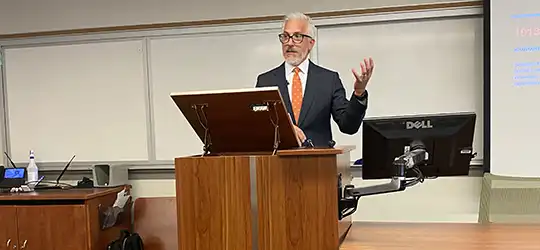
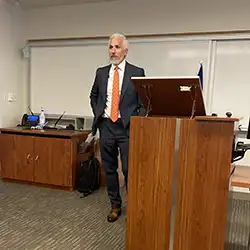
Those were just some of the topics covered by Dr. Alex Garza, SSM Chief Community Health Officer, when he spoke to law students and faculty recently at Saint Louis University’s School of Law.
Garza, who led the St. Louis region’s response to the pandemic, was there to discuss “Needs, Benefits and Not-for-Profit Healthcare,” and in so doing gave a brief history of patient care and healthcare law in the U.S.
“The U.S. is the only economically developed country that does not provide universal access to healthcare, so it is more of a commodity, with some exceptions, than a public good,” he stated.
Part of the challenge in providing access to healthcare for all, he said, is that American medical care is more of a patchwork quilt than a determined design. As early as 1935, Garza noted, President Franklin D. Roosevelt tried to create universal healthcare as part of the Social Security Act. However, he withdrew the plan when it appeared that including it with the establishment of Social Security would prevent the bill’s passage.
Garza said he is an optimistic person and is “hopeful” that the country can solve its healthcare challenges. “I wouldn’t say that I’m here because I have all the answers but because I’ve spent a great deal of time wrestling with the questions,” he said.
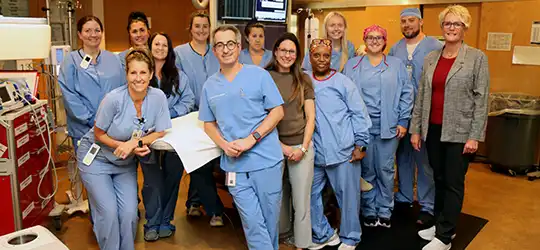
He also works to address some of the gaps. As a not-for-profit, mission-driven healthcare system, SSM Health serves all people regardless of their ability to pay. It also engages with communities to meet a range of health, equity, and social needs.
Garza noted that the “social determinants of health” – conditions outside the walls of a hospital or doctor’s office – are the main factors affecting a person’s health, not a checkup.
“These are things such as access to food, transportation, and housing, among others,” he said.
“These are wicked problems shaped over generations by policy, economics, geography, and social conditions,” Garza added.
While health systems and hospitals can be instrumental in addressing those issues, he said, it will take every one of us to cause the change that is needed.
“Community benefit can support access, prevention and healthier communities, but it cannot substitute for universal access to healthcare or resolve the structural gaps that leave millions uninsured or underinsured,” he said.
It also can’t change the economic model used in the U.S. healthcare system, which heavily favors a for-profit strategy, he added.
“The central question for us today, then, is not only whether not-for-profit hospitals are fulfilling their obligations. It is also whether we are asking community benefit to compensate for problems that require broader public-policy solutions.”