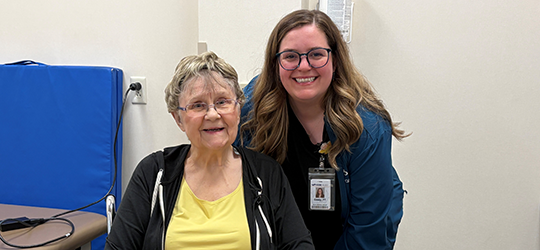
As a registered nurse and health care leader, Susan Alwin-Popp spent her entire career caring for others. Then, in June 2021, she suddenly found herself on the other side.
While getting ready for work one morning, Alwin-Popp began to feel unsteady. She struggled to walk and quickly realized something was wrong. She asked her husband, Tom, to take her to the emergency room.
They learned she had suffered a serious stroke and, in an instant, her entire life changed.
“I went from being independent and working a lot to not being able to do anything by myself,” Alwin-Popp said. “It was like my body belonged to someone else.”
After initial stroke treatment and rehabilitation, Alwin-Popp was determined to get back to the life she knew. But the reality of the situation was heavy. She eventually had to make the painful decision to retire, and a series of additional setbacks continued to complicate her day-to-day life.
“It was a very demoralizing but humbling experience,” Alwin-Popp said. “I used to be the one cheering people on as they recovered from something like a stroke, but I didn’t truly understand the depth of recovery until I had to go through it myself.”
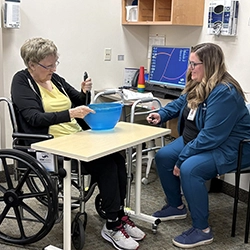
As Alwin-Popp continued to rehab, her physical therapist, Casey Mathews, was mindful of the emotional challenges that accompanied the physical demands she was tasked with reteaching.
She thought long and hard about Alwin-Popp's needs and wondered if a new FDA-approved technology called Vivistim could help.
Vivistim pairs rehabilitation exercises with gentle vagus nerve stimulation through a small, implanted device. The vagus nerve stimulation is paired with therapy exercises to help the brain create new pathways when trying to complete a task. This helps with relearning movements used to do things like lifting a utensil or getting dressed.
“Susan met all the criteria and honestly there couldn't have been a better patient for this procedure,” Mathews said. "We decided to speak with neurosurgeon Dr. Elena Gutierrez about it."
Alwin-Popp was approved to receive the surgery but was then set back again due to a heart attack. It would take another year to regain enough strength to requalify.
Finally, in January 2025, SSM Health neurosurgeon Dr. Gutierrez was able to complete Alwin-Popp's surgery. What happened next exceeded everyone's expectations.
After weeks of demanding 90-minute therapy sessions, Alwin-Popp began to notice something remarkable.
“I started to be able to move again,” she said. “I could make my body do what I wanted it to, and I couldn't believe it.”
Before Vivistim, Alwin-Popp's left arm often seemed determined to do the opposite of what she wanted. Pain radiated through her shoulders, and her hand would curl inward and move uncontrollably.
Today, after many hours of practice and continued therapy, Alwin-Popp can shower, dress herself, cut her own food and complete many of the tasks she once feared she had lost forever. She's also regaining her ability to walk.
While Alwin-Popp is grateful for the technology that helped fuel her recovery, she is quick to credit most of her success to the dedicated SSM Health team members who have cheered her on, offered exceptional guidance, and truly listened.
“I want to show everyone going through stroke that there is hope,” Alwin-Popp said. “It's not just words—I'm someone who is proof.”
SSM Health offers exceptional emergency care and advanced treatment options for stroke and stroke recovery. To understand your risk for stroke and learn more about services offered, visit https://www.ssmhealth.com/services/neurosciences/stroke.