
Diagnostic Services
SSM Health offers comprehensive diagnostic testing that help your providers maintain your heart health. Diagnostic services are available on both an inpatient and outpatient basis. Using advanced technologies help us properly identify patients who are at risk for heart attacks and heart disease.
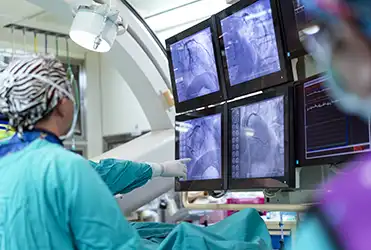
If your doctor ordered a cardiac catheterization, you might have a few questions about the procedure. Don't worry, we've got you covered.

Electrophysiology (EP) studies provide detailed evaluations of the electrical activity in your heart.
If you doctor is concerned about your heart or vascular health they may order any number of diagnostic tests. These test allow your doctor to get a better idea of what may or may not be happening with your heart.
What is a cardiac stress test?
A cardiac stress test is an exercise tolerance test. During a stress test, you’ll walk on a treadmill or ride an exercise bike for a specific amount of time. While you are exercising an EKG machine measures the electrical flow in your heart. This allows your physician to see how the heart functions during physical stress.
What is cardiac catheterization?
Cardiac catheterization is a special X-ray that allows your doctor to examine the heart and coronary arteries. You will be awake during the procedure, and it typically takes less than one hour.
- During the procedure, your physician will insert a thin, flexible tube (called a catheter) into an artery in your arm or leg.
- The catheter is then passed through, toward your heart, with your doctor following its movement on a TV monitor.
- Once the catheter is in place, your doctor will inject dye (contrast) to help pinpoint any problems with your coronary arteries.
- When the procedure is complete, your physician will remove the catheter, and a nurse or technician will apply pressure for 15 to 20 minutes.
Where is a cardiac cath performed?
Your cardiac cath will take place in the hospital in a specialized laboratory called a cath lab.
Cardiac catheterization is usually performed in a hospital. Before your cardiac catheterization, your physician will arrange for you to have several routine tests, including an EKG, blood work and a chest X-ray.
Your doctor will also provide you with a few instructions to follow before your procedure. Be sure to follow these specific instructions to properly prepare for the procedure.
After your cardiac catheterization, your physician will return to explain your results . Sometimes the procedure will show that your heart is just fine. If there is a problem though, your physician will discuss all possible treatments.
Plan to take it easy for a few days after the procedure. Avoid heavy lifting, and stick to light activities for a few days. You may have a small bruise or lump the size of an olive under the skin at the insertion site. This should go away within a few weeks.
Reasons to call your doctor post-cardiac catheterization:
- The insertion site bleeds
- You feel chest pain or discomfort
- Your arm or leg feels numb or cold
- The bruising or swelling gets worse or increases
- You have a fever
- Signs of infection appear at the insertion site
What if a narrowing or blockage is found during my cardiac cath?
If your cardiac catheterization reveals a blockage or narrowing in the coronary arteries your health may be in jeopardy. In the case of a narrowing or blocked artery, your interventional cardiologist may perform a balloon angioplasty or stent procedure.
Vascular stenting, which is often performed at the same time as angioplasty, involves placing a small wire mesh tube called a stent in your newly opened artery. The stent is a permanent device that is left in the artery to help keep the artery open.
What is an echocardiogram?
An echocardiogram is a painless, non-invasive procedure that uses ultrasound waves to help “visualize” the movements of the heart’s valves and chambers on a monitor.
What's a transesophageal echocardiogram (TEE)?
Your doctor may decide on a TEE because they need a more detailed look at your heart or a standard echocardiogram would not provide a clear enough image. A transesophageal echocardiogram is a different way to perform an echocardiogram. A thin, flexible tube is passed down a patient's esophagus ultrasound waves to help your doctor see the movements of the heart’s valves and chambers.
What is an electrophysiology study?
Electrophysiology (EP) studies provide detailed evaluations of the electrical activity in your heart. The advanced electrophysiology labs at SSM Health were created to better serve our patients with electrical problems of the heart.
What conditions are treated with electrophysiology?
Common conditions treated with electrophysiology including atrial fibrillation and other types of arrhythmias. Using cardiac mapping, our electrophysiologists can identify the cause of your irregular heartbeat, oftentimes correcting it through the use of ablation. Learn more about ablation.
Did you know electrophysiologists do more than EP studies? They can also:
- Implant pacemakers if a patient is experiencing a slow heart rate.
- Implant cardiac defibrillator that delivers electrical impulses, helping a patient’s heart return to a normal rhythm after experiencing a severe arrhythmia.
What electrophysiology services does SSM Health offer?
When receiving treatment in our electrophysiology lab, you and your heart are our number one concern. We offer a variety of electrophysiology services, including:
- Diagnosis of arrhythmias
- Risk assessment of ventricular arrhythmias
- Catheter-based treatments for AFib, atrial flutter, supraventricular tachycardia, and ventricular tachycardia
- Biventricular pacemaker implantation
- Implantation and management of defibrillations
- Lead extraction
- Care for patients with congenital heart disease or inherited arrhythmia disorders
Did you know specialized electrophysiology equipment protects your heart during treatment?
To protect your heart we use the CARTO™ X-Press electroanatomical navigation system. This technology uses saline to prevent your heart’s surface from becoming too hot due to the radio-frequency power. It also allows us to deliver treatment deeper into the tissue.
Additional diagnostic testing for heart patients:
Your doctor may ask you to wear a holter monitor, which is a machine that continuously records your heart rhythm. This monitor records your heart rhythm during normal activity over a 24-hour period.