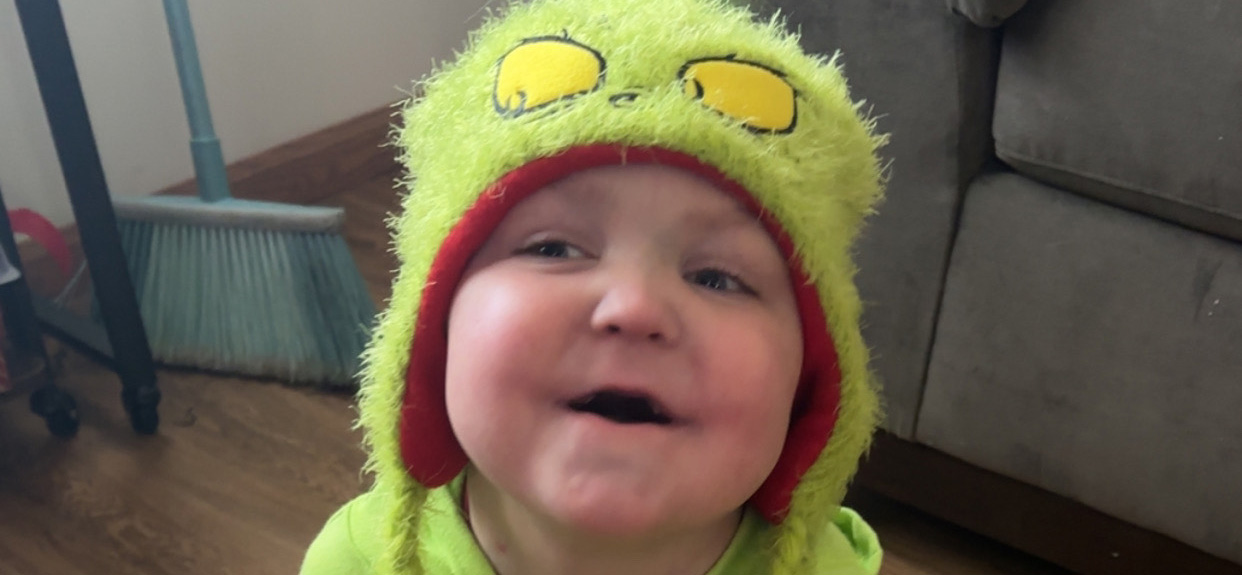
The day after getting home from major spinal surgery, 7-year-old Kenzie was already making plans. “Can I ride my 4-wheeler around?” she asked. Her father and mother, Kyle and Heather Davison, were surprised. In one day, Kenzie had grown three inches taller, stood straighter and, for the first time in years, wasn’t huffing and puffing just to breathe.
“Before, she couldn’t take a deep breath because her lungs were being squished by her spine,” said Heather Davison. “After her surgery, the doctors said her oxygen level and lung expansion increased dramatically.”
Kenzie’s great outcome was thanks to a novel procedure using MAGnetic Expansion Control (MAGEC) rods. The rods, which help straighten severe spinal curvatures, “grow” and lengthen as a child grows. They are approved for certain children with severe progressive scoliosis.
“Infantile scoliosis, which means diagnosed before the age of 4, is very uncommon, accounting for less than 5% of all scoliosis,” said orthopedic surgeon Dustin Baker, MD, director of pediatric orthopedics at SSM Health Cardinal Glennon Children’s Hospital. “It is difficult to treat because the body continues to grow and, because of that, we can’t do a spinal fusion yet.”
Kenzie was diagnosed with early onset scoliosis when she was 4 years old. It was discovered by accident as she underwent x-rays to check on her lungs and heart. “She was born with heart and lung-related problems, but the doctors said they saw that her spine curved in the x-ray and referred us to an orthopedic specialist,” Davison recalled. “It was something unexpected.”
The family soon learned that Kenzie’s spine was “S” shaped, with two abnormal curves bending as much as 50 degrees. It was recommended that Kenzie be fitted with a removable plastic brace, which she had to wear 23 hours a day. “It was very uncomfortable, and she just didn’t want to wear it,” said Davison.
When Kenzie had to undergo a fifth heart surgery, the decision was made to put bracing on hold until after Kenzie recovered. By then, her curvature had progressed to as much as 65 degrees. It remained that way until doctors noted a jump in the abnormal curvature from 65 to 75 degrees in just six months.
Said Dr. Baker, “The worsening of this curvature is a direct result of Kenzie growing. She had a lot of growth remaining, and there was potential for the curves to become very severe and negatively impact pulmonary function.”
Advances in Spinal Surgery
A typical treatment option for severe scoliosis is the implantation of rods that are surgically attached to the spine above and below abnormal curves to straighten the spine. The problem in young children who have not finished growing is that surgeons must go back in and lengthen the rods every few months. It meant that some children would undergo up to a dozen surgeries before they reached skeletal maturity.
The MAGEC rods make that process obsolete for young children. These devices have a magnet inside the rods. After the initial surgery to attach the rods to the spine, doctors can use a remote-controlled device on the outside of the back to lengthen the rods every few months to maintain the corrected position of the spine while the patient grows. Lengthening takes minutes in the doctor’s office instead of multiple procedures in an operating room. It will only be after Kenzie is fully grown when surgeons will do one more procedure to remove the rods and fuse her spine.
“She loves to swim and runs around taking care of her chickens and quail, her two German shorthair pointers and playing with her puppy, Emma,” said Davison with a smile. “She doesn’t huff and puff anymore and she’s having fun. That’s what we want her to do — have fun.”
Learn more about orthopedic spine services at SSM Health Cardinal Glennon Children's Hospital.