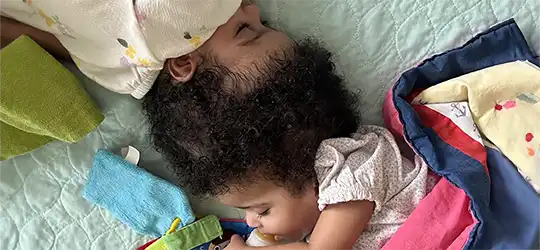
“They said they had never seen a baby who looked like ours. I remember wondering why did this happen to our baby; what did I do to make him have these problems,” recalls Sherry Habbe as she tells the story of how they found out something was wrong with their baby boy.
 Sherry and husband RH were at their 20-week ultrasound, excited to hear if their new baby would be a boy or girl, excitement turned fear when the sonographer quickly left the room in search of their doctor. The first doctor to look at the ultrasound wasn’t sure what to make of the images on the screen. “They thought it might be gastrochsisis or omphalocele because he had a distended abdomen. Then, another doctor thought it could an enlarged bladder,” she says.
Sherry’s physician referred them to a high-risk obstetrics team, who couldn’t see her for a few days. “I found the St. Louis Fetal Care Institute online, and called first thing Monday morning. They were able to see me that day, and gave me hope for our son’s future,” says Sherry.
The team at the Fetal Care Institute confirmed that their son Douglas had bladder outlet obstruction and possible Eagle-Barrett syndrome, along with resulting club feet due to low amniotic fluid levels. The most common cause of bladder outlet obstruction, posterior urethral valves, is a blockage in a male fetus’ bladder. This prevents the flow of urine out of the body, which in turn prevents normal development of other major organs. Mild cases may only require observation during pregnancy and further evaluation after birth. In severe cases, however, fetal surgery may be the best option.
Typically, the earlier the obstruction is diagnosed, the more severe the condition because there is a higher chance of severe kidney and bladder dysfunction, as well as poor lung development. The kidneys and lungs are linked in development through the amniotic fluid, which is made by the fetal kidneys. In turn, the fetus “breathes” the fluid, which exerts small but necessary pressure within the lungs, promoting growth.
When the urine cannot get out of the bladder, the amount of amniotic fluid begins to decline leading to poor lung growth. Eagle-Barrett Syndrome, formerly known as Prune Belly Syndrome or Triad Syndrome, is a group of three associated birth defects: poor development of the abdominal muscles, which causes the skin of the belly area to wrinkle like a prune, undescended testicles and urinary tract problems.
“Our options were to do nothing, end the pregnancy, or we could try to do fetal surgery for the bladder outlet obstruction,” Sherry recalls. “We were told all the risks of fetal surgery with one being I could go into labor; another being he could pull out the shunt needing multiple procedures. They were risks I was willing to take. I had to try to fight for our son,” she says.
Douglas’ kidneys were still functioning, but the bladder outlet obstruction presented a risk for further kidney damage and decreased lung development. Fetal surgery could help him by restoring the normal flow of urine into the amniotic fluid, allowing the kidneys and lungs to develop.
The team determined that the placement of a vesicoamniotic shunt would provide the best likelihood of a positive outcome for Douglas. The shunt is a small flexible tube that is placed through the fetal skin, into the baby's bladder and allows urine to pass into the amniotic cavity (the bag of water). It can increase the potential for normal pressure in the fetal kidneys and bladder as well as normal fluid in the amniotic cavity. This establishment of normal amniotic fluid allows for the best chance of normal lung development.
On Aug. 2, 2013, Sherry had the minimally invasive fetal surgery at SSM Health St. Mary’s Health Center. After surgery, the Fetal Care Institute team, and her OB/GYN closely monitored Sherry and Douglas. The amniotic fluid levels improved, along with Douglas’ lung and kidney development.
“It was hard to enjoy this pregnancy; it was hard to go shopping for baby things and clothing. We didn’t know what would happen to Douglas after he was born, we didn’t know how long he would be in the NICU (neonatal intensive care unit). It made me sad not being able to prepare for him like I had with our daughter,” recalls Sherry.
As patients of the Fetal Care Institute, Sherry and RH were able to meet with many of the pediatric specialists who would provide care for Douglas after delivery, and tour the NICU and other SSM Health Cardinal Glennon Children’s Medical facilities before his arrival. “It was so helpful to have a relationship started with them and knowing it wasn’t perfect strangers taking care of our son,” she says.
On Nov. 11, 2013 the decision was made that it was time for Douglas to make his arrival. Sherry was showing signs of oligohydramnios or decreased level of amniotic fluid, and the team felt the safest thing to do for Douglas was to induce delivery.
Sherry’s labor would be induced on Nov. 13. “The night before delivery I was scared, it was a sleepless night. I wanted to hold my little girl tight because I didn’t know when I would be home with her again,” she recalls.
When she was ready to deliver, Sherry was moved to an operating room where a team of Cardinal Glennon neonatologists were awaiting Douglas’ arrival. After the team drained the urine from around Douglas’ kidney in-utero, Douglas made his entrance to the world.
“He cried! I was overjoyed to hear him cry for the first time. None of us knew if he would be able to cry. The doctor held him up so I could look at him and he was whisked away to the NICU team. I wanted to hold him but he needed the help of doctors,” Sherry says.
Sherry was taken to her hospital room while the neonatologists worked to stabilize Douglas. When he was born Douglas had trouble breathing because of his underdeveloped lungs and abdominal wall muscles. He also had Stage IV chronic kidney disease.
“When the transport team brought him in; he looked so tiny in his bed, he had breathing tubes, and IV’s, I will never forget the sound that the monitors used by the transport team make. I cried as they took my baby from me,” she recalls. RH went with Douglas to Cardinal Glennon, where he would receive care in the Level IV NICU while Sherry recovered from delivery.
That evening brought special meaning to one of Sherry’s favorite stories that she often reads to her children, On The Night You Were Born written by Nancy Tillman. She recalls one of her favorite verses from the book when thinking about Douglas’ delivery day: “On the night you were born, the moon smiled with such wonder that the stars peeked in to see you and the night wind whispered, 'Life will never be the same.' Because there had never been anyone like you ever in the world. Heaven blew every trumpet and played every horn on the wonderful, marvelous night you were born. For you are fearfully and wonderfully made.”
Douglas spent nearly three months in the NICU, where he underwent several complex surgeries to on his urinary tract. The first surgery was when he was one day old, and the longest, when he was eight weeks old, lasted six hours. Along the way, a team of specialists, including neonatologists and pediatric nephrologists monitored him constantly, treating infections, ensuring he was getting enough nutrition, and making sure his lungs and kidneys were working as well as possible.
During this time Sherry and RH also had their three-year old Rylee at home. “Having another child while one is sick is the hardest part. We tried to keep everything in terms she would understand. She’s been sick before so we told her Douglas was sick. We tried to prepare her for his NICU stay. We would tell her that when mommy has brother that he will have to stay at the hospital while doctors make him feel better. It was hard splitting time between two children,” says Sherry.
Feb. 5, 2014 was an exciting day for the family. Douglas was discharged from the NICU. “It was a cold snowy day. We left the NICU after Douglas’ 1 p.m. feeding. We stopped at Grandma’s house to get our daughter so the four of us could all go home together. Rylee was so excited to finally have her brother home. She was the first person to hold him,” says Sherry. “Thankfully, we had wonderful nurses in the NICU that trained us very well in his care. Getting a routine going at home was a challenge. The first night at home felt so nice having both my kids asleep in their beds; the way it was supposed to be from the beginning.”
Douglas is now a happy, growing, one-year old who is closely followed by the team of pediatric specialists at Cardinal Glennon. Only one of his kidneys functions, and it drains directly to his diaper for now. “Douglas had an incredibly difficult group of problems that nobody had ever seen, including blockages of his urethra and both kidneys. He’ll need more surgery to reconstruct his urinary tract when he’s older, but we’re all thrilled with how well he’s done so far, and are optimistic about his chances for a happy future.” says Dr. Barry Duel, Director of Pediatric Urology.
Douglas loves Mickey Mouse and playing games like peek-a-boo. “He has developmental delays because of his prune belly, but he is finally sitting alone, and trying to figure out how to get to a sitting position on his own,” says Sherry.
Throughout all of this, Sherry says she has learned that, “I am stronger than I ever thought I was. To love and cherish my children more, people don’t know how lucky and blessed they are to have healthy children and to not take anything for granted.”
For other families facing a similar situation, she recommends, “Don’t give up hope. The road will be long and bumpy but it is all worth it in the end. There are days when I feel defeated, like the next day I can’t do it but then Douglas gives me a smile and I know I can do it all for him. It’s easy to blame yourself – I still do; even though I know that it wasn’t anything I did to my son and that nothing could have changed what happened to him. Remember to love, to allow yourself to cry, to mourn the loss of a normal pregnancy and accept what God has given to you. Don’t forget to fight – take risks it may pay off with a beautiful child. It won’t be the baby or the pregnancy you planned but it is the baby that was meant to be.”
Sherry also notes that she has found new meaning in her favorite Gary Allen song Life Ain't Always Beautiful, “Because remember life ain’t always beautiful but it is a beautiful ride. Remember to enjoy every second of it. The ups and downs, and remember that life will get better.”
Sherry and husband RH were at their 20-week ultrasound, excited to hear if their new baby would be a boy or girl, excitement turned fear when the sonographer quickly left the room in search of their doctor. The first doctor to look at the ultrasound wasn’t sure what to make of the images on the screen. “They thought it might be gastrochsisis or omphalocele because he had a distended abdomen. Then, another doctor thought it could an enlarged bladder,” she says. Sherry’s physician referred them to a high-risk obstetrics team, who couldn’t see her for a few days. “I found the St. Louis Fetal Care Institute online, and called first thing Monday morning. They were able to see me that day, and gave me hope for our son’s future,” says Sherry.
The team at the Fetal Care Institute confirmed that their son Douglas had bladder outlet obstruction and possible Eagle-Barrett syndrome, along with resulting club feet due to low amniotic fluid levels. The most common cause of bladder outlet obstruction, posterior urethral valves, is a blockage in a male fetus’ bladder. This prevents the flow of urine out of the body, which in turn prevents normal development of other major organs. Mild cases may only require observation during pregnancy and further evaluation after birth. In severe cases, however, fetal surgery may be the best option.
Typically, the earlier the obstruction is diagnosed, the more severe the condition because there is a higher chance of severe kidney and bladder dysfunction, as well as poor lung development. The kidneys and lungs are linked in development through the amniotic fluid, which is made by the fetal kidneys. In turn, the fetus “breathes” the fluid, which exerts small but necessary pressure within the lungs, promoting growth.
When the urine cannot get out of the bladder, the amount of amniotic fluid begins to decline leading to poor lung growth. Eagle-Barrett Syndrome, formerly known as Prune Belly Syndrome or Triad Syndrome, is a group of three associated birth defects: poor development of the abdominal muscles, which causes the skin of the belly area to wrinkle like a prune, undescended testicles and urinary tract problems.
“Our options were to do nothing, end the pregnancy, or we could try to do fetal surgery for the bladder outlet obstruction,” Sherry recalls. “We were told all the risks of fetal surgery with one being I could go into labor; another being he could pull out the shunt needing multiple procedures. They were risks I was willing to take. I had to try to fight for our son,” she says.
Douglas’ kidneys were still functioning, but the bladder outlet obstruction presented a risk for further kidney damage and decreased lung development. Fetal surgery could help him by restoring the normal flow of urine into the amniotic fluid, allowing the kidneys and lungs to develop.
The team determined that the placement of a vesicoamniotic shunt would provide the best likelihood of a positive outcome for Douglas. The shunt is a small flexible tube that is placed through the fetal skin, into the baby's bladder and allows urine to pass into the amniotic cavity (the bag of water). It can increase the potential for normal pressure in the fetal kidneys and bladder as well as normal fluid in the amniotic cavity. This establishment of normal amniotic fluid allows for the best chance of normal lung development.
On Aug. 2, 2013, Sherry had the minimally invasive fetal surgery at SSM Health St. Mary’s Health Center. After surgery, the Fetal Care Institute team, and her OB/GYN closely monitored Sherry and Douglas. The amniotic fluid levels improved, along with Douglas’ lung and kidney development.
“It was hard to enjoy this pregnancy; it was hard to go shopping for baby things and clothing. We didn’t know what would happen to Douglas after he was born, we didn’t know how long he would be in the NICU (neonatal intensive care unit). It made me sad not being able to prepare for him like I had with our daughter,” recalls Sherry.
As patients of the Fetal Care Institute, Sherry and RH were able to meet with many of the pediatric specialists who would provide care for Douglas after delivery, and tour the NICU and other SSM Health Cardinal Glennon Children’s Medical facilities before his arrival. “It was so helpful to have a relationship started with them and knowing it wasn’t perfect strangers taking care of our son,” she says.
On Nov. 11, 2013 the decision was made that it was time for Douglas to make his arrival. Sherry was showing signs of oligohydramnios or decreased level of amniotic fluid, and the team felt the safest thing to do for Douglas was to induce delivery.
Sherry’s labor would be induced on Nov. 13. “The night before delivery I was scared, it was a sleepless night. I wanted to hold my little girl tight because I didn’t know when I would be home with her again,” she recalls.
When she was ready to deliver, Sherry was moved to an operating room where a team of Cardinal Glennon neonatologists were awaiting Douglas’ arrival. After the team drained the urine from around Douglas’ kidney in-utero, Douglas made his entrance to the world.
“He cried! I was overjoyed to hear him cry for the first time. None of us knew if he would be able to cry. The doctor held him up so I could look at him and he was whisked away to the NICU team. I wanted to hold him but he needed the help of doctors,” Sherry says.
Sherry was taken to her hospital room while the neonatologists worked to stabilize Douglas. When he was born Douglas had trouble breathing because of his underdeveloped lungs and abdominal wall muscles. He also had Stage IV chronic kidney disease.
“When the transport team brought him in; he looked so tiny in his bed, he had breathing tubes, and IV’s, I will never forget the sound that the monitors used by the transport team make. I cried as they took my baby from me,” she recalls. RH went with Douglas to Cardinal Glennon, where he would receive care in the Level IV NICU while Sherry recovered from delivery.
That evening brought special meaning to one of Sherry’s favorite stories that she often reads to her children, On The Night You Were Born written by Nancy Tillman. She recalls one of her favorite verses from the book when thinking about Douglas’ delivery day: “On the night you were born, the moon smiled with such wonder that the stars peeked in to see you and the night wind whispered, 'Life will never be the same.' Because there had never been anyone like you ever in the world. Heaven blew every trumpet and played every horn on the wonderful, marvelous night you were born. For you are fearfully and wonderfully made.”
Douglas spent nearly three months in the NICU, where he underwent several complex surgeries to on his urinary tract. The first surgery was when he was one day old, and the longest, when he was eight weeks old, lasted six hours. Along the way, a team of specialists, including neonatologists and pediatric nephrologists monitored him constantly, treating infections, ensuring he was getting enough nutrition, and making sure his lungs and kidneys were working as well as possible.
During this time Sherry and RH also had their three-year old Rylee at home. “Having another child while one is sick is the hardest part. We tried to keep everything in terms she would understand. She’s been sick before so we told her Douglas was sick. We tried to prepare her for his NICU stay. We would tell her that when mommy has brother that he will have to stay at the hospital while doctors make him feel better. It was hard splitting time between two children,” says Sherry.
Feb. 5, 2014 was an exciting day for the family. Douglas was discharged from the NICU. “It was a cold snowy day. We left the NICU after Douglas’ 1 p.m. feeding. We stopped at Grandma’s house to get our daughter so the four of us could all go home together. Rylee was so excited to finally have her brother home. She was the first person to hold him,” says Sherry. “Thankfully, we had wonderful nurses in the NICU that trained us very well in his care. Getting a routine going at home was a challenge. The first night at home felt so nice having both my kids asleep in their beds; the way it was supposed to be from the beginning.”
Douglas is now a happy, growing, one-year old who is closely followed by the team of pediatric specialists at Cardinal Glennon. Only one of his kidneys functions, and it drains directly to his diaper for now. “Douglas had an incredibly difficult group of problems that nobody had ever seen, including blockages of his urethra and both kidneys. He’ll need more surgery to reconstruct his urinary tract when he’s older, but we’re all thrilled with how well he’s done so far, and are optimistic about his chances for a happy future.” says Dr. Barry Duel, Director of Pediatric Urology.
Douglas loves Mickey Mouse and playing games like peek-a-boo. “He has developmental delays because of his prune belly, but he is finally sitting alone, and trying to figure out how to get to a sitting position on his own,” says Sherry.
Throughout all of this, Sherry says she has learned that, “I am stronger than I ever thought I was. To love and cherish my children more, people don’t know how lucky and blessed they are to have healthy children and to not take anything for granted.”
For other families facing a similar situation, she recommends, “Don’t give up hope. The road will be long and bumpy but it is all worth it in the end. There are days when I feel defeated, like the next day I can’t do it but then Douglas gives me a smile and I know I can do it all for him. It’s easy to blame yourself – I still do; even though I know that it wasn’t anything I did to my son and that nothing could have changed what happened to him. Remember to love, to allow yourself to cry, to mourn the loss of a normal pregnancy and accept what God has given to you. Don’t forget to fight – take risks it may pay off with a beautiful child. It won’t be the baby or the pregnancy you planned but it is the baby that was meant to be.”
Sherry also notes that she has found new meaning in her favorite Gary Allen song Life Ain't Always Beautiful, “Because remember life ain’t always beautiful but it is a beautiful ride. Remember to enjoy every second of it. The ups and downs, and remember that life will get better.”