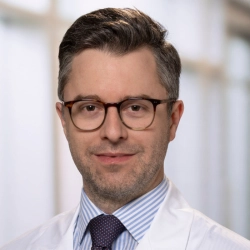
As Director of AI in Radiology for SSM Health St. Mary’s Hospital – St. Louis and SSM Health Saint Louis University Hospital, Dr. Michael Moritz isn’t just studying the future of artificial intelligence in healthcare, he’s helping to build it.
An assistant professor of diagnostic radiology at Saint Louis University School of Medicine, Dr. Moritz combines clinical practice, research, and education to advance the responsible use of AI in medicine. His work has earned national recognition through publications in NEJM AI, Nature Biomedical Engineering, and The Lancet, positioning him among a growing group of physician leaders shaping how artificial intelligence will transform patient care.
Most recently, Dr. Moritz co-authored a study published in NEJM AI, the artificial intelligence journal from the New England Journal of Medicine Group. The research introduced a large, expertly annotated dataset linking written radiology findings to their precise locations on chest CT scans in order to train AI models to identify and describe the abnormalities.
The publication reflects Dr. Moritz’s broader mission: helping healthcare responsibly harness AI to improve patient care while enabling clinicians to focus on the work that matters most.
“AI is going to take over a lot of what physicians and administrators now spend their day doing,” Dr. Moritz said. “That doesn’t shrink our role—it moves everyone up a level, toward harder problems and higher-value work, and lets us do more for more patients.”
Advancing AI beyond radiology
The NEJM AI publication is one of several recent scholarly contributions from Moritz exploring how artificial intelligence can reshape healthcare.
In 2025, he served as first author on a paper published in Nature Biomedical Engineering describing how coordinated AI agents could work alongside patients and healthcare professionals to improve communication, decision-making, and care delivery. He also authored a commentary in The Lancet examining the emerging risks of adversarial AI adoption across the healthcare ecosystem, highlighting the importance of thoughtful governance as AI becomes more deeply integrated into medicine.
Beyond his research, Dr. Moritz serves on the Society of Imaging Informatics in Medicine’s Artificial Intelligence Committee and directs Saint Louis University School of Medicine’s AI in Radiology clerkship, helping prepare the next generation of physicians to responsibly integrate AI into clinical practice.
Bringing AI into clinical practice
While contributing to AI research on an international stage, Dr. Moritz is also helping integrate AI into everyday radiology practice across SSM Health.
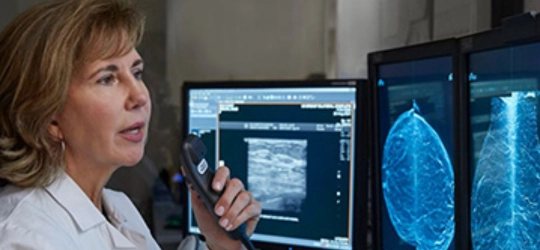
Today, radiology teams use FDA-cleared AI applications to help identify conditions such as stroke and intracranial hemorrhage, while breast imaging specialists use AI-assisted mammography tools to support diagnosis. Dr. Moritz has also collaborated on AI-powered solutions designed to summarize relevant patient history from the electronic health record, giving radiologists faster access to critical clinical information before interpreting imaging studies.
Looking ahead, he believes the next generation of AI will go far beyond identifying a single abnormality.
“Instead of AI looking for one specific finding, it’s going to recognize hundreds or thousands of different findings and generate a draft report for physician review,” Dr. Moritz said. “That has the potential to improve efficiency, consistency and ultimately patient care.”
Addressing healthcare’s biggest challenges
Dr. Moritz believes AI has the potential to help healthcare organizations address many of their greatest challenges, including workforce shortages, rising costs, and expanding access to care.Rather than replacing healthcare professionals, he envisions AI taking on repetitive and administrative work so physicians, nurses, and other caregivers can devote more time to complex clinical decision-making and meaningful patient interactions.
He also believes AI’s greatest strength will come from its ability to analyze information across multiple sources simultaneously, including medical images, pathology slides, electrocardiograms, and electronic health records, to uncover insights that would be nearly impossible for humans to detect on their own.
At the same time, Dr. Moritz emphasizes that thoughtful implementation remains essential. As AI becomes more widely adopted by patients, healthcare providers, insurers, and other stakeholders, maintaining physician oversight, regulatory safeguards, and patient trust will remain critical to its successful integration into healthcare.
Looking toward the future
Although AI has advanced rapidly over the past few years, Dr. Moritz believes healthcare is still in the early stages of what’s possible.
He expects future AI systems will combine imaging, pathology, laboratory data, electrocardiograms, and electronic health records into large multimodal models capable of uncovering entirely new insights into disease diagnosis and treatment.
For clinicians and healthcare leaders, his advice is simple: stay curious.
“If you tried AI a year ago and weren’t impressed, try it again,” Dr. Moritz said. “The technology is improving incredibly fast, and we’re only beginning to see what’s possible.”
As SSM Health continues exploring innovative ways to improve care, Dr. Moritz believes AI will serve as a powerful tool to support, not replace, the expertise, compassion, and judgment of healthcare professionals, ultimately helping teams deliver better care to more patients.