
Saint Louis University Liver Center
A Center of Excellence for Treatment of Liver Diseases
By combining the clinical and research resources of Saint Louis University and SSM Health Saint Louis University Hospital, the Saint Louis University Liver Center helps to diagnose, treat, cure and educate the public about liver diseases. Our staff includes some of the highest-profile doctors and research scientists in the country — many of whom have been named in the Best Doctors, Inc. database, a national, independent medical reference service.
As liver specialists in Saint Louis University's division of gastroenterology and hepatology, we see more than 1,200 patients per month with various types of liver diseases. We have one of the largest hepatology practices in the world, treating more than 2,000 patients annually.
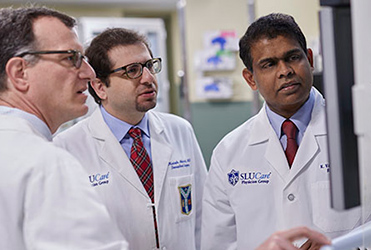
Learn more about how the liver works, what liver disease is, and how your SLUCare Physician Group provider can help.

Learn more about how dream team of doctors at SLUCare are treating Fatty liver disease (NASH) and hepatitis C.
Treatment at Saint Louis University Liver Center
Our physicians specialize in diagnosing and treating liver diseases that range from the evaluation of mild enzyme abnormalities due to fatty liver to the management of severe, complicated, end-stage liver disease in patients awaiting liver transplantation.
Conditions We Treat
- Alpha-1 antitrypsin deficiency
- Fatty liver disease (NASH)
- Hepatitis C
- Hepatitis B
- Hepatorenal syndrome
- Liver cancer
- Primary sclerosing cholangitis
Percutaneous liver biopsy is often needed for the evaluation of patients with any type of liver disease. Saint Louis University's extensive experience in outpatient liver biopsy allows for safe and cost-effective testing, and our close working relationships with expert hepatic pathologists ensures an accurate diagnosis.
The Liver Center's ongoing clinical research activities allow patients to be included in protocols evaluating various new therapies for the treatment of liver diseases. Through clinical trials, new treatments are identified, and patients often find personal satisfaction participating in research that may help many people in the future. SLU Liver Center was a leader in hepatitis C treatment trials; now those therapies have become standard treatments, preventing the need for liver transplantation.
Liver Transplant Services with SSM Health & SLUCare
Through SSM Health Saint Louis University Hospital, the Saint Louis University Liver Center's transplant service is approved by UNOS, certified by Medicare and designated as a center of excellence by several major insurance providers. Recognizing that continuity of pre- and post-operative care is just as essential to successful outcomes as the actual surgery, our multidisciplinary team is dedicated to providing the full spectrum of care to liver transplant patients.
Saint Louis University hepatologists work closely with the liver transplant surgeons and the pre- and post-transplant coordinators to develop an individualized plan for each patient.
The goal of the Liver Center is to provide patients with efficient and cost-effective care from evaluation to post-transplant follow-up.
On the Forefront of Liver Research
Saint Louis University Liver Center is committed to excellence in liver research, with physicians and scientists working side by side to acquire new knowledge of liver function, causes of liver diseases and applicable treatments.
Many different academic disciplines contribute to our research. Our team includes experts in:
- Biochemistry and Molecular Biology
- Biology
- Gastroenterology and Hepatology
- Hematology and Oncology
- Infectious Diseases
- Molecular Microbiology and Immunology
- Pathology
- Pediatric Gastroenterology
- Neonatology
- Radiology
- Interventional Radiology
- Surgery
National Leadership in Clinical Trials
Saint Louis University Liver Center takes research from the lab to patient treatment. As a leading liver research center, we are continually engaged in multi-center clinical trials and can offer our patients access to the latest advances in care.
Clinical trials may be offered at no charge through pharmaceutical companies or through the National Institutes of Health Clinical Studies Unit.
To learn about clinical trials, please call the GI/Hepatology Clinical Studies Unit at 314-977-9400 to speak with a research coordinator.
Liver Disease Facts
The liver is the largest organ in the body. Consisting of several lobes, the liver is found under the ribs on the right side of the body and is important in removing harmful material from the blood, making enzymes and bile that help digest food, producing proteins that help with blood clotting and many other functions, and converting food into substances needed for life and growth.
The liver is the only organ in the body that is able to regenerate or completely repair damage with new cells. However, long-term complications can occur when regeneration is either incomplete or is prevented by progressive accumulation of scar tissue. Once scar tissue has developed, it is very difficult to reverse the process. Severe scarring is known as cirrhosis and indicates late-stage liver disease that is often followed by complications.
Approximately one in 10 Americans is affected by liver and biliary disease. Up to 50 percent of these people have no symptoms. The most common symptoms of liver disease are vague, including fatigue or excessive tiredness, lethargy and occasionally itching. More prominent signs of liver disease include jaundice, or yellowing of the eyes and skin, dark urine, very pale or light colored stool, bleeding from the gastrointestinal tract, mental confusion, and retention of fluids in the abdomen. The first sign of liver disease often is abnormal blood tests.
Hepatitis is inflammation of the liver caused by viruses, medications, an unregulated immune system or other factors. There are multiple types of viral hepatitis, including hepatitis A, B, C, D, E, cytomegatolovirus, herpes virus, and Epstein-Barr virus (mononucleosis). Hepatitis B and C have the greatest potential for long-term liver damage. Vaccinations prevent hepatitis A and B, but not there is not a vaccine for hepatitis C.
- Hepatitis A is acquired from contaminated food or water.
- Hepatitis B is usually acquired by sexual contact, from mother to child at childbirth, or intravenous drug use.
- There are 1.2 million people in the United States with hepatitis B.
- One out of every 250 people is a carrier of hepatitis B and can pass it on to others — through contact with blood or body fluids — often unknowingly.
- Hepatitis B is 100 times more infectious than HIV, the virus that causes AIDS.
- There are 500 million hepatitis viral particles in one teaspoon of blood compared to 5 to 10 HIV particles.
- Hepatitis C alone is five times as widespread as HIV.
- More than 4 million people (1.9 percent of the population) have been exposed to hepatitis C and most do not know that they are infected.
- The virus is spread through infected human blood or blood product transfusions before 1992.
- Fortunately, very effective and well-tolerated therapy is now available as a result of clinical trials over the past two decades.
- Patients and the SLU Liver Center played a major role in developing these new treatments.
Hemochromatosis is a genetic disease of iron metabolism that results in excess iron deposits throughout the body. The disease may lead to the development of cirrhosis, diabetes, skin pigment changes, cardiac problems, arthritis and testicular atrophy. Life expectancy is normal if hemochromatosis is diagnosed before these complications develop, and the diagnosis is easily suspected by measuring iron levels in the blood. A genetic test is also available, thanks to Dr. Bacon and the patients of the SLU Liver Center who led to this discovery.
Friends of The Liver Center
Friends of the Saint Louis University Liver Center is an organization that raises money to support research, treatment and public education about liver disease. Many members have a personal interest in The Liver Center since they or a close friend or relative have a liver disease.
The immediate goal of the Friends is to raise funds to support SLU's ongoing research programs in liver disease, including hepatitis C, and to hire new investigators and researchers. A longer-term goal is to raise funds to establish two or more endowed chairs in liver research at Saint Louis University. The group's ultimate goal is to establish a named, endowed liver research facility, consolidating all of the Center's activities into a single location.
To request additional information or to support the Saint Louis University Liver Center, call the Friends of the Saint Louis University Liver Center at 314-576-3078. Need Information? Email us at liverctr@health.slu.edu.
Saint Louis University Liver Center Locations
Center for Specialized Medicine
Patient Care
1225 South Grand, Third Floor
St. Louis, MO 63104
314-257-3760
Get Directions to Center for Specialized Medicine
Saint Louis University Liver Center
Research Activities
Attn: Myron Minner, MBA, RHIA, Manager
SLUCare Academic Pavilion
1008 S. Spring Ave.
St. Louis, MO 63110
314-977-2185