
Elbow Pain
Elbow pain can make everyday tasks—like lifting, driving, or turning a doorknob—hard and uncomfortable. Pain might start suddenly or slowly get worse over time. It is often due to overuse of the elbow or a previous injury.
What are common symptoms of elbow pain?
Some elbow pain might go away on its own. Try resting your arm, taking over-the-counter medicine to reduce pain and swelling, and using ice or heat to help the area feel better. Other symptoms may be a reason to visit an orthopedic specialist or sports medicine specialist, including:
- A sudden injury from a fall or lifting a heavy object
- Pain that keeps you from straightening your arm
- Pain that causes difficulty with sleeping or daily activities
- Pain that does not improve with over the counter medications, rest, ice, and heat
Elbow Conditions
- Tendonitis — A tendon attaches muscle to bone and facilitates movement of the elbow joint. Tendons can become inflamed or damaged from overuse or injury, causing pain and loss of movement.
- Tennis elbow (Lateral epicondylitis) — People experience pain on the outside of the elbow. Most people with this condition don’t play tennis but do engage in repeated motion of the hand and wrist.
- Golfer's elbow (Medial epicondylitis) — This is a painful condition centered on the inner side of the elbow. It’s caused by repeated stress on the muscles in the forearm and wrist.
- Olecranon bursitis — This is when a small, fluid-filled sac at the tip of the elbow becomes inflamed and fills with more fluid. It can cause pain, visible swelling, and difficulty bending the elbow.
- While the condition can last for months, it usually isn't serious. But if the sac at the tip of the elbow becomes infected or starts to train fluid, medical attention may be necessary.
- Ulnar collateral ligament (UCL) tears — This happens when the ligament on the inside of the elbow is damaged from repeated stress.
- This is especially common in baseball pitchers. This can lead to ongoing elbow pain, slower pitch speed, and less control when throwing.
- Because pitching puts a lot of stress on the elbow, an Orthopedic surgeon reconstructs or replaces the injured ligament with a healthy tendon. This is called Tommy John surgery.
Explore other elbow care resources
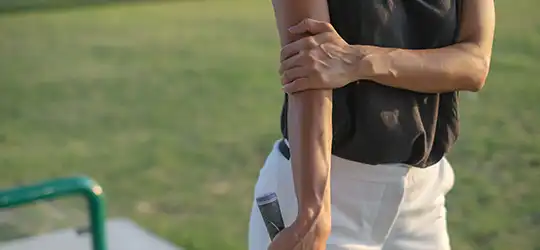
How to avoid common golf injuries
Golfers are especially prone to injury due to the repetitive motions needed in each swing. Follow these tips so you can improve your golf game and continue to play throughout your life.

How to stay safe while playing baseball
Learn more about how to avoid common baseball injuries in young athletes.
- Elbow dislocations — This typically happens from a fall or accident. This requires that the elbow be put back in place in the emergency room.
- A brace, splint, or sling needs to be worn for a short period of time to keep the area still.
- Distal biceps tears — This happens when the tendon that connects the biceps muscle to the elbow is torn. This often happens when lifting something heavy, such as furniture or weights at the gym.
- In almost all cases, the tendon requires surgery for reattachment back to the bone where it tore from.
- It happens almost exclusively in men.
- Cubital tunnel syndrome — This is when the ulnar nerve (funny bone nerve) is compressed or stretched along the back/inside of the elbow. Pain along the inside of the elbow as well as numbness in the ring and small fingers are typical symptoms.
- Sometimes, the nerve in the elbow gets stretched when a person sleeps with their arm bent. Wearing a soft brace at night can help keep the arm straighter and protect the nerve. If this doesn’t help, surgery may be needed to relieve pressure on the nerve.
How is elbow pain diagnosed?
Your doctor will ask questions about the type and frequency of the pain you are experiencing and perform a thorough physical exam. If required, an X-ray, MRI, or an other form of imaging may be used to isolate the problem.

How is elbow pain treated?
We understand that every patient has individual needs and goals for orthopedic care. We will work with you to develop a personalized treatment plan that respects your lifestyle and priorities.
Lifestyle changes
- Exercise can strengthen your muscles and improves motion
Non-surgical treatment options:
A non-surgical approach is often the first line of defense for elbow pain. Treatment often begins with rest, over-the-counter medications, and the use of heat or cold therapy. Depending on your situation, your doctor may also recommend one or more of the following:
- A shot of cortisone may relieve mild, chronic inflammation and pain.
- The elbow can benefit from the stabilization and support a brace or splint can offer.
- Depending on the situation, it may allow you to continue using the joint in activities and daily life.
- Physical therapy offers a combination of exercise and stretching. This can reduce pain and increase flexibility of muscles around the affected joint.
- Tylenol and anti-inflammatory medications can help reduce pain.
Surgical options:
Arthroscopy is a minimally invasive procedure. Arthroscopy uses small cuts and special tools. These tools help fix or remove the damaged covering of the bone and joints.
Ligament reconstruction fixes or replaces a damaged ligament. It usually uses a graft from another body part or sometimes a tested cadaver. This restores stability and function to the affected joint.
This usually means making one or more large cuts to reach the problem area. It helps the surgeon work more precisely and is often used for complex procedures, like fixing serious bone breaks.
Common questions about elbow injuries:
To treat the pain and continue to golf, protect the elbow by stretching, using a brace, and icing after your round.
The symptoms of tennis elbow will usually resolve within six months but may take a year or longer. Ice, bracing or compression, and resting the joint can help speed recovery.
- Elbow injuries in the throwing athlete - OrthoINfo - AAOS. (n.d.-b). https://orthoinfo.aaos.org/en/diseases--conditions/elbow-injuries-in-the-throwing-athlete/